Showing posts with label conflict management. Show all posts

Freedom Begins in the Mind

Recently, I've been spending time watching the new baby black crested mangabey at the zoo where I volunteer. His name is Sullivan. He's about two months old now—still tiny, still dependent on his mother's milk, still very much a baby. 

baby black crested mangabey named Sullivan, pretending to eat some straw

But something fascinating is happening. He's begun picking up pieces of lettuce and bringing them to his mouth. He's not actually eating the lettuce yet. He's copying his mother.

Photo of female black crested mangabey named Suzy eating a peace of lettuce

Watching him has been a delightful reminder that humans are apes too, and we learn much the same way. Before we understand the world, before we can reason about it, we imitate. We watch others. We mimic their behaviors. We absorb the habits, beliefs, fears, and preferences of the people around us.

baby black crested mangabey named Sullivan playing with a blue block while laying on straw at the Chattanooga Zoo

This ability to learn through observation is one of our species' greatest strengths. It allowed human knowledge and culture to accumulate across generations. We don't each have to rediscover fire, invent language, or figure out social rules from scratch.

But this remarkable ability comes with a cost. The same brain that allows us to learn from others also makes us susceptible to being influenced by them. And that is why freedom begins in the mind.

When we think about freedom, we often think about external things—freedom of speech, freedom of movement, freedom from oppression. These freedoms matter enormously. But there is another kind of freedom that is just as important and often overlooked:

The freedom to think for yourself.

Your Brain Is Designed to Be Influenced

Every day, our thoughts, beliefs, and behaviors are being shaped by forces around us. Advertisers compete for our attention. Social media algorithms reward outrage and conformity. Peer groups exert pressure to fit in. Political movements, cultural narratives, and even workplace dynamics all attempt to influence what we believe and how we behave.

Most of this influence is not malicious. It is simply part of being human.

We evolved to be social because, for our ancestors, belonging to the group often meant survival. Individuals who paid attention to what others were doing and copied successful behaviors had an advantage.

The baby mangabey doesn't need anyone to explain to him that lettuce is food. He watches his mother and begins practicing the behavior long before he fully understands it.

Humans do the same thing.

Children imitate language, emotional reactions, social norms, and cultural beliefs long before they are capable of critically examining them. As adults, we continue to imitate, often without realizing it. We adopt opinions from our social groups, absorb assumptions from our cultures, and unconsciously respond to rewards and punishments in our environments.

Over time, these influences can become so deeply ingrained that we mistake conditioned responses for freely chosen decisions.

Freedom Requires Self-Awareness

The question is not whether we are influenced. We all are.

The question is whether we understand those influences well enough to choose how we respond to them.

Psychological freedom begins with self-awareness.

The moment we start asking questions, we reclaim power:

  • Why do I believe this?
  • Who taught me to think this way?
  • Is this belief based on evidence or social pressure?
  • Am I acting from my values or reacting from fear?
  • Does this choice reflect who I want to be?

These questions interrupt automatic responses and create space for conscious choice.

Freedom lives in that space.

This is why critical thinking is so important. It is not merely an intellectual skill. It is a form of self-defense.

A person who understands behavioral psychology, cognitive biases, and social influence becomes significantly harder to manipulate. They become less dependent on social approval and more capable of acting according to their own values.

The Five Managerial Superpowers and Mental Freedom

Many people think leadership is about influencing others. But ethical leadership begins with learning to lead ourselves.

In Mastering the Five Managerial Superpowers, I explore five essential capacities that help individuals reclaim control over their thinking and behavior:

  • Self-awareness
  • Compassion
  • Self-control
  • Understanding behavioral science
  • Managing conflict constructively

These are not merely management skills.

They are freedom skills.

Self-awareness helps us recognize when emotions and social pressures are driving our decisions.

Compassion allows us to understand others without becoming captive to their approval or disapproval.

Behavioral science teaches us how habits, rewards, and environments shape behavior—both our own and that of others.

Conflict management helps us resist manipulation through fear, intimidation, and social pressure.

Together, these skills create something powerful:

Psychological independence.

The ability to think clearly, act ethically, and choose deliberately instead of simply reacting.

Reclaiming Your Mind

Watching that little mangabey has reminded me of something profound.

Copying others is not a flaw in human nature. It is one of our greatest evolutionary strengths.

But maturity requires something more than imitation. At some point, we must move beyond merely copying the behaviors and beliefs around us and begin consciously deciding which ideas deserve our loyalty.

Freedom does not mean becoming immune to influence. That would be impossible.

Freedom means becoming aware of the forces shaping us and intentionally choosing which influences align with our values.

It means learning to pause before reacting.

It means questioning narratives, examining assumptions, and choosing principles over pressure.

Because while we cannot control everything happening around us, we can learn to better control how we respond.

That is where freedom begins.

Not in governments.
Not in institutions.
Not in other people.

But in the mind.

And perhaps one of the greatest forms of freedom available to human beings is this: the ability to understand how we are shaped, and then consciously choose who we wish to become.

If you would like practical tools for developing that kind of psychological independence, Mastering the Five Managerial Superpowers explores the behavioral science, self-awareness, and leadership skills that can help you become a more intentional, ethical, and resilient human being.

Because before we can lead others well, we must first learn how to lead ourselves.

Hack Your Brain: Mastering the 5 Managerial Superpowers

 What if I told you that your brain is running on autopilot most of the time? That your reactions, decisions, and even conflicts are often driven by deeply ingrained habits rather than conscious thought? The good news is that you can take control. You can hack your brain, reprogram it for success, and become the leader—or simply the person—you want to be.

That’s exactly what my book and course, Mastering the 5 Managerial Superpowers, are designed to teach. Using behavioral science, I guide you through the process of rewiring your brain to manage yourself, your responses, and ultimately, your interactions with others more effectively. Here’s how:

Step 1: Build Your Foundation – Self-Awareness & Compassion

Before you can change anything, you need to understand how your brain works. Most of us operate on autopilot, reacting to situations based on past experiences and deeply ingrained patterns. Developing self-awareness allows you to recognize these patterns. Pairing that with compassion—for yourself and others—creates the space for real change.

Once you’re aware of how you react, you can begin to practice self-control. This is the key to breaking automatic responses and gaining the ability to choose how you respond instead of letting emotions or old habits take over.

Step 2: Hack Your Brain Using Behavioral Science

The science of change is clear: small, intentional shifts create lasting transformation. Your brain thrives on reinforcement and repetition. This means that with deliberate practice, you can create new neural pathways that make strategic thinking your default instead of knee-jerk reactions.

This is where behavioral science techniques come into play. By understanding how habits form and how reinforcement works, you can train your brain to make better choices automatically. The result? You become more effective in managing yourself, your work, and your relationships.

Step 3: Manage Conflict by Managing Your Response

Conflict is inevitable—but how you respond to it determines the outcome. The difference between escalating a conflict and resolving it effectively comes down to one thing: your response.

When you learn to pause, assess, and choose your response strategically, you take control of the situation rather than letting it control you. This shift empowers you to handle even the most difficult interactions with confidence and clarity.

Your Superpower Awaits

Mastering these skills isn’t just about leadership—it’s about harnessing the power of your own mind to create the outcomes you want. When you learn to control your responses, you gain the ultimate superpower: the ability to shape your own reality.

Ready to start hacking your brain for success? Check out Mastering the 5 Managerial Superpowers and unlock the skills that will change the way you lead, work, and live.

De-escalating conflicts - online or via text

I was asked a question by someone taking my online course: How to De-Escalate Conflicts Using Science. They asked: “What happens if other person will only deal with you via internet, etc.,, not in person or on telephone?”


That was all they texted me, so I did not have the full context of their situation, and when I responded they told me they had already used my ideas to help resolve the situation and it was indeed resolved favorably. What a great endorsement of my course! 

I thought it would be helpful to share what I told him as this is a very common problem. 

How to Handle Text Conflicts

Assume you have someone you text with who you are having trouble with. So everything is written.

The problem with written communication is that we don’t have any of the normal emotional cue signaling that happens with voice tone and facial cues.  It is very, very hard to read what someone else is thinking about when you share something via text, and it is very common to read into communications things that aren’t actually there.  This is especially common if they just don’t respond.

My Advice

If they are giving no actual sign they are offended, don’t assume they are.  

If you think they might be – it is acceptable to ask them for feedback.  Is what you sent ok, are they frustrated, or angry or anything?  Most people will respond and ease your mind.  Keep in mind, some people read emails and don’t acknowledge them at all.  If you need a response, ask for one. If something is important, I usually ask for confirmation of receipt just to be sure they saw it. 

If there is an actual conflict and they are telling you something isn’t ok, it may not be possible to fix via text. So much of how we respond emotionally to others is tied to tone of voice and facial cues.   


This doesn't mean you can't try. Of course you can try. 

Taking a Humanistic Approach

Whenever I have a conflict with someone, online or in person, I go into compassion/professional mode and check my own feelings first.  I make sure that my communications are attempts to clarify and gain clarity with them. I make sure there is no animosity on my side by activating compassion.  Do I see them as fully human? Deserving of compassion?  I should. Because they are humans deserving of compassion. 

This one thing I do, is 90% of de-escalating conflicts. I have to first de-escalate myself.  

Final Word

At the end of the day if you have someone who is just refusing to communicate with you there is not much you can do. But I would not take it personally. Their communication preferences have everything to do with them and nothing to do with you.

Learn More

If you want to learn more about how to de-escalate conflicts using science and humanist philosophy - check out my course:

https://humanistlearning.com/de-escalate-conflicts/

If you want a more in-depth exploration of how to manage conflicts humanistically - I have an 8 hour certificate program in Humanistic Conflict Management

https://humanistlearning.com/conflict-management-discount-bundle/


Mastering Humanistic Conflict Management: A Path to Ethical and Compassionate Resolution

In today's fast-paced and interconnected world, conflicts are inevitable. Whether they arise in the workplace, within communities, or even in our personal lives, how we manage and resolve them speaks volumes about our character and professionalism. Enter the realm of Humanistic Conflict Management – an empowering journey that equips you with the tools to navigate conflicts with grace, empathy, and effectiveness.

My 8-hour certificate program is designed to revolutionize the way you approach conflict resolution. Gone are the days of simply reacting to conflicts; instead, we empower you to proactively address them with a blend of empathy and professionalism.

One of the cornerstones of our program is the integration of behavioral science principles into conflict resolution strategies. By understanding the underlying psychological dynamics at play, you'll gain invaluable insights into human behavior, allowing you to navigate conflicts with finesse and precision. More importantly, you'll learn how to regulate your own emotional responses, a critical skill in de-escalating tense situations and fostering constructive dialogue.

But what happens when the problem isn't conflict - but bullying and harassment? Our program doesn't shy away from the tough questions. We provide you with actionable strategies to address such challenging scenarios ethically and effectively. By learning behavioral science, you'll be equipped to tackle even the most daunting conflicts or bullying situations with integrity and compassion.

Central to Humanistic Conflict Management is the art of turning conflicts into opportunities for collaboration. Here, the Socratic method emerges as a powerful tool. By asking probing questions and encouraging dialogue, you'll learn how to dismantle barriers, build bridges, and foster mutual understanding. Conflict ceases to be a battlefield; instead, it becomes a fertile ground for innovation and growth.

Join us on this transformative journey and unlock the power of Humanistic Conflict Management. Whether you're a seasoned professional seeking to enhance your skills or an aspiring leader looking to make a positive impact, this program is your roadmap to a more harmonious and productive future.

Embrace conflict not as a threat, but as an opportunity for growth and connection. Enroll in our Humanistic Conflict Management program today and embark on a journey towards a brighter, more compassionate tomorrow.

https://humanistlearning.com/conflict-management-discount-bundle/

This course offers HRCI & SHRM credits through our learning partner Learn Formula. https://hr-credits-us.learnformula.com/course/humanistic-conflict-management-certificate-program

CPE Continuing education: 

 It also meets the standards of: PMI (Project Management Institute), CMA (Canadian Marketing Association), DMI (Digital Marketing Institute)

Resolving Conflict Between Managers

A reporter recently reached out to me to ask me how I would approach resolving conflicts between managers. Here is my response. 


1. How do you resolve conflicts between managers in the workplace?

Ideally – you shouldn’t have to. Managers should be adults who know how to resolve disagreements civilly and effectively in the best interests of the organization.  But – if they aren’t good at resolving differences and it turns into a conflict, then yes, upper management (usually HR) has to get involved.  

If I were coaching managers on how to deal with this (and I do have online courses that teach this), the first thing I do is encourage both compassion and responsibility.  The other person probably means well and if you can get out of your head enough – you can listen to their objections and help resolve the disagreement by making either a compromise or sorting it out – as adults do.  

The first approach is to always assume both parties mean well and have valid reasons for their actions – and to figure out what those are. Often – just encouraging both sides to view each other as allies and not enemies is enough to jump start the process.

If one side refuses to do this – then – you have a problem. 

2. Why do you need to resolve conflicts swiftly? 

Disagreements should not escalate into conflicts and if they have – you have a problem.  Dealing with it swiftly is important because a) you don’t want it to escalate further and b) the longer it goes on – the harder it is to bring the parties back into allyship to resolve it. Once disagreements turn into conflicts – tribal thinking takes over and people can really solidify their opinions that the “other” side is evil or insane. If allowed to fester, those biases will negatively impact all work going forward. You need you team to think of themselves as being on the same team – not enemies.

3. How can you avoid conflicts in the first place? 

Foster a humanistic workplace. Reward managers for collaboration. If you keep getting conflicts – either the managers shouldn’t be managers or your reward system within the organization is rewarding the conflicts or both.  Sears is a famous example of this.  They made managers compete with one another instead of rewarding them for collaboration and the result was disastrous.

More practically – practice and encourage – collaborative problem solving as the cultural norm within the organization. 

4. What are some other ways in which you can foster a healthy work environment?

Actively reward collaboration and happy employees.  Keep reinforcing compassion for people who disagree and the dignity and worth of every individual in the company.  Also – not everyone is cut out to be a manager. If someone just can’t handle the pressure and doesn’t know how to positively reinforce people – teach them – explicitly – how to do this. 

5. At what point does HR need to get involved in a conflict between managers? 

As soon as it becomes obvious – that this is a conflict and not simply a disagreement.  If managers can’t resolve disagreements without it becoming a conflict – then something is wrong. Get involved.  Treat both sides with dignity and recognize their worth and help them see that in each other. 

6. Is there anything else you'd like to add?

Learning how to deal with conflict, and bullying are basic management skills. Train your new managers on how to handle interpersonal problems. If you don’t train them – don’t expect them to magically – know how to handle difficult interpersonal situations. 

Learn more by taking one of my HRCI & SHRM approved courses at https://humanistlearning.com/


Resolving a dispute in the workplace

I teach the Socratic method for resolving disputes in the workplace. There is a reason this methodology has been taught for thousands of years. It works. 


This technique assumes the other person is not being a bully or abusive – but is a normal well-intention ed person who you disagree with. However, even if the other person is being abusive – this will still work – just for different reasons.

The basic idea is that – you stop advocating for what you want. You don’t – let it go – you just set it aside to do – some learning first.

And you ask questions to try and understand where the other person is coming from and more importantly WHY they are advocating or saying the things they are. Everyone in the workplace is under stress.  They may be short and just rather demanding. And they may not have explained why this crazy thing that makes no sense has to happen. When you step back – you can ask supportive questions and get that information and integrate it into your ask.  Which is the 2nd part.

Once you know – really know and understand what is driving the other person – you can adjust your side of what you want and need to incorporate everyone’s concerns and create a win win solution that will help everyone. This is what leaders do well.  It’s what makes a manager – a leader.

To do this – you need compassion – to view the other person – not as an adversary – but as a colleague who is struggling with something. And humility to understand the world isn’t just about you and your needs. Other people matter too.

And yes, this works. As soon as people do this – it transforms their conversations into things that can be collaboratively solves instead of fights to be won.  My course – by the way is called – how to win arguments without arguing. There is a reason this technique has been taught for millennia. It’s effective.

As to what happens when you use this with a bully – it disarms them. This isn’t about allowing someone to walk over you. It’s about working WITH someone. If that person isn’t capable of working WITH people – that will become clear, but don’t assume that’s the case unless they really resist. What generally happens is that you can neutralize a bully so that they stop bullying you – because their bullying isn’t working. It’s not as simple as that – obviously – but it’s often what happens. You become their ally and they start seeing you as an ally and they start treating you differently and you can – control them through niceness.

If they are have a mental health issue though – they will just spin out of control. The key when dealing with an abusive person is to get any agreement that is made through this process – in writing. So that there can be accountability later if the person is a bully and doesn’t do what they promised to do. You use that written agreement – to re-enter socratic inquiry – but – with witnesses.

Hope this helps – let me know if you have any other questions.

My course and book are available at: https://humanistlearning.com/book-how-to-win-arguments-without-arguing/

If people are dealing with a bullying boss – I have a program for that as well. https://humanistlearning.com/book-program-how-to-humanistically-handle-bad-bullying-bosses/


How can you use technology to streamline a conflict resolution process?


I provide online training on how to stop unwanted behavior like bullying/harassment using behavioral science. This knowledge can also be applied to conflict management and I have several programs which address how to do that.

The question – can a tech solution to help streamline conflict resolution is an interesting one.  Because the answer is – it depends.  It depends on what exactly is happening.

Conflict isn’t simply a disagreement. It’s a disagreement that has devolved into a personal fight – at least on one side. Often on one side. It’s an unprofessional response to a professional disagreement.

Conflict can also be a symptom of bullying. Where the bully uses conflict to justify their behavior.  Bullying often masquerades as conflicts. 

With these 2 things in mind – there are a couple of things HR can do to use tech to help them.

1.    They can use tech to help provide training to the people “in conflict” to help them learn how to better and more professionally deal with it so it stops being a conflict and goes back to being a disagreement.  This does not take the place of counseling and coaching though. It’s more – complementary to counseling and coaching. The person coaching the individuals through the “conflict” can have them read things or take an online class as part of the counseling/coaching.

2.    The other way they can use tech is as a whistleblowing/reporting  system.  Because conflicts are manifested as inappropriate and unprofessional workplace behaviors, the goal is to get the unprofessional behavior to stop. Additionally, since what looks like conflict may actually be bullying, providing staff with a way to report incidences of unprofessional behavior will help HR a) know what is going on and b) provide a record of unwanted/unprofessional behavior which can be used to justify employment action is retraining fails, which it often will if the problem is bullying. Basically – a whistleblower/reporting system can help you figure out if what is happening – is actually bullying, when used correctly.

To learn more - take one or several of my courses at: 

I am an HRCI & SHRM approved provider. 


Advice on dealing with workplace conflicts

What are your best suggestions for dealing with workplace conflict? Why are they effective?

My first bit of advice to to: REMAIN PROFESSIONAL!!!! 

My second bit of advice is to make sure it's a conflict - and not something else. 

One of the problems with dealing with workplace conflicts, is – sometimes it isn’t a conflict. Sometimes it’s something else.  What looks like a conflict might actually be bullying.

And you solve bullying/harassment problems in a very different way than you solve conflicts. 

For instance, if you have someone who is actively sabotaging another person through passive aggressive behavior, it’s not something you can work through. The other party has no interest in fixing the problem because creating a problem is the point.

Regardless of what is happening, remaining professional is going to help. 

I have a rule, you don’t engage in conflict resolution until the inappropriate workplace behavior stops.  So if someone is justifying yelling at someone because of “conflict.” The first thing that must stop is the yelling or other inappropriate workplace behavior. Participants are encouraged to resolve their problems professionally and in a dignified way.

If what is happening is a conflict, this will work. If it’s not a conflict – it won’t. But that’s ok because what happens when it is not a conflict is that the person who is behaving inappropriately – will continue to do so and it becomes a LOT easier to see where the problem is and deal with it when it becomes explicit like this.

So – behave professionally. Focus on solving the problem. If the other person refuses to solve the problem – that’s on them. Properly documenting these interactions are sufficient to bring attention to management if it turns out one of the parties is NOT interested in resolving the problem.

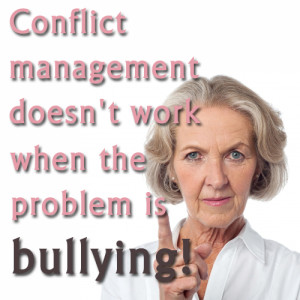
I actually have a book and online training on ‘Why Conflict Management Doesn’t Work When the Problem is Bullying.’ https://humanistlearning.com/conflictresolution/

I recommend that managers use a bullying elimination model whenever they have a ‘conflict.’ That way what is reinforced is appropriate professional workplace behavior and professional resolution of disputes. 

Because let’s face it – the only time disputes become a problem is when they result in inappropriate workplace behavior.  If you focus on fixing the inappropriate behavior – you create the conditions in which professional disagreements are resolved professionally. Failure to address inappropriate behavior masquerading as conflict – just creates more problems.

Conflicts and Compromise

Conflicts happen. The challenge is knowing how to deal with them effectively, knowing when to compromise and when to hold your ground.

I teach how to use behavioral techniques to diffuse conflicts and deal with harassment and retaliation.  I also teach a class on why conflict management doesn’t work when the problem is bullying.  Finally, I also have a course on how to win arguments by not arguing – called – Socratic Jujitsu.  All of these programs are science based.

Let’s assume we are dealing with a conflict that is based on a real disagreement and not with something that is actually irrational and happening because people have implicit biases that are effecting how they are interacting with others.

1)      As long as a disagreement is professional, it can be resolved.  If the disagreement is manifesting as unprofessional behavior, it can’t be. Sniping, name calling, passive aggressive behavior, interrupting, denigrating comments and more – are all unprofessional. If that is happening, what is happening, isn’t just a disagreement and those other behaviors have to be addressed before conflict resolution can occur.

2)      The key to conflict resolution is respect. Both parties must get to a point where they step back and respect that the other person is holding their other opinion for a valid reason and that once we know what that is – we can work through the differences.  Assuming there is an actual disagreement on the best way to move forward, one side can take the initiative to start asking questions so that cooperative problem solving can occur.

When should you give up? That depends. Do you feel like this is mission critical? Or not. If not – then perhaps just lodging your disagreement and then allowing whatever to go forward will be fine. Who knows, you may have been wrong and the other person may have been right. But if you are absolutely convinced this is a mission critical issue and that the project will fail if something isn’t addressed, then fight for it. Just be aware, the best way to do that is to ask questions that introduce doubt into the mind of the person you are disagreeing with.  The goal is to move from conflict to cooperative problem solving.

Want to learn more- check out these online courses:


A different perspective on conflict management

Conflict management assumes that parties to a conflict have some sort of rational disagreement. But what if the problem isn’t a conflict? Or, what if there is a conflict, but it isn’t about anything that can be rationally discussed?

We humans are tribal animals. People who are in our tribe, we like, people who are not we don’t. If we have a problem with someone’s behavior, we almost always label them as a problem and as other and as soon as we do that, everything they do, we will find a way to fault them.  This is tribal thinking and it’s REALLY common and it’s not rational, it’s instinctual.

What basically happens is – we decide we don’t like someone (often for rather arbitrary reasons) and then we find ways to rationalize our dislike by looking at what they are saying and/or doing and taking issue with it.  These then become the basis of our “conflicts.”

While the individuals involved can almost always articulate why they are in “conflict” with another person, the conflict itself is actually a manifestation of an underlying behavioral and instinctual dynamic that is playing out.  In these cases, resolving the conflict doesn’t actually resolve the real conflict.

This is why effective approaches to conflict management are designed to help the conflicted parties see each other as valid and human. It’s about bringing the “other” person into the fold of the tribe, however that is defined by them. Once that happens, the parties can usually start rationally discussing the “conflict” and resolve it by coming to some sort of agreement.

But sometimes this isn’t possible because one side or the other will just flatly refuse to see the other person as valid. When this happens, another approach is needed because, what is happening, is beyond reason. What is needed in these situations is a behavioral approach.  The goal is still to help the individuals see each other as valid. It’s just that in some cases, people’s tribal habits are so ingrained, they can’t just – overcome them rationally. These people need to a behavioral intervention to help them break the bad habit of tribally segregating people.

This is also one of the reasons why humanistic leadership is so important. The basis of the approach is to view everyone as part of the same tribe so that that we minimize tribal thinking in the first place.

To learn more – check out this online course.
Why Conflict Management Does Work When the Problem is Bullying - https://humanistlearning.com/conflictresolution/


It’s Not a Conflict!

Realistic suggestions for handling the bullying issue. Don’t treat it as a conflict.

Bullying may look like a conflict. You might think the bully is bullying because they are in conflict with their victim. They may even tell you – I don’t like this person and give you a bunch of reasons why their bad behavior toward their victim is justified.

What you need to understand as a humanistic manager or leader tasked with resolving these “conflicts,” is that bad behavior is never justified!  Even if it was true, and the other person was doing something horrid, all someone is telling you when they try to justify their bad behavior because someone else behaved badly is this: they aren’t in control enough of their behavior to deal with whatever the problem they think they have rationally.

Rational, intelligent, professional and civilized people don’t behave badly

Rational, intelligent, professional and civilized people don’t behave badly when they conflict with other people. In fact, and I know this will come as a shock to some of you, but there are people who can remain friendly with people they disagree with. Shocking I know, but it’s true and it’s what we should be striving towards, both personally and professionally.

So … if you have someone behaving badly and they are telling you they are behaving badly because – of some conflict. Understand that they have just told you they need help controlling their behavior and offer them that help.  Their bad behavior was not the way to deal with whatever it was they were dealing with and if they behave that way again, there will be consequences!!!!

I realize this sounds a lot like parenting advice. And it is. Because when adults behave badly – they aren’t behaving like professional civil adults, because professional civil adults don’t behave badly.  When someone tells you they aren’t capable of behaving professionally during conflicts, accept their poor assessment of themselves.

It's a Cop-Out

Also realize that this cop out is the favorite justification of bullies. It’s the way they deflect attention off of their bad behavior and onto another person who “caused” them to behave badly. This victim blaming is childish. Something 5 year olds do. Don’t allow your workers to act like 5 year olds. Hold them to adult professional standards.

If you want to learn more about why conflict resolution doesn’t work when the problem is bullying, check out this course: https://humanistlearning.com/conflictresolution/

The Limitations of Conflict Management

Conflict management techniques are really useful, but not in every situation.

Not every interpersonal problem is a conflict. Conflicts are basically people disagreeing and not figuring out how to agree. This does happen, but often, what looks like a conflict is actually something else entirely.

If someone is passive aggressive and withholding information in the workplace, then yes, they are going to be in conflict with a lot of people. There will be disagreements that are pretty much impossible to resolve. We are tempted to employ conflict resolution tactics to resolve these conflicts. The problem is that you can’t resolve a passive aggressive problems  or bullying/harassment problems with conflict resolution. Here’s why.

A passive aggressive person avoids conflict. Their aversion to conflict is great enough that they will go to great lengths to avoid seeming to have a conflict. Put them in a conflict resolution mediation situation and they will acquiesce to everything that is said, and then continue being passive aggressive. Mediation won’t change anything. Why? Because that’s how they have learned to cope. They avoid conflict and “win” and “control” what is happening in other ways.

Bullying also can’t be fixed with conflict resolution because what is happening isn’t a “conflict.” It’s bullying. Sure, the person who is being bullied might respond to the bullying by entering into a conflict with their bully. But the underlying problem is that one person is behaving inappropriately (which is why it’s bullying and not conflict) and that bullying/harassment behavior is setting of a chain reaction of bad behavior between them and their victim. Conflict resolution assumes that both sides are equally guilty. But in a bullying situation, one side is to blame and the other is responding however poorly to that bad behavior.  Conflict resolution exacerbates bullying/harassment situations so it’s critical to understand when to use conflict resolution and when not to.

I gave a talk to a group of coaches a few weeks ago and we discussed this very dilemma. For me, I don’t consider using conflict resolution until both parties are behaving civilly. Because let’s be clear. Disagreements aren’t a problem. They are to be expected in normal human interactions. It’s how we respond to those disagreements that matters. If we respond civilly, there is no problem. There is only a problem if one or both parties responds by behaving badly.

My first task is to get the parties involve behaving civilly. Only after they start behaving properly and eliminate the bad behavior (whether it is passive aggressive or outright bullying), can we consider conflict resolution.

Always deal with the inappropriate behavior first. Don’t allow people who are behaving inappropriately to get away with it under the guise of conflict. If they really are in conflict fine. You can deal with their conflict, but only if they start behaving like the professionals they are. Conflicts are no excuse to behave uncivilly.

People who are capable of being civil, will try being civil and will work with you to resolve the problem. People who aren’t, because they have passive aggressive control issues or because they are chronic and habitual bullies, won’t behave civilly because they don’t know how and this will tell you pretty much everything you need to know about what is really going on.

To learn more about why conflict resolution doesn’t work when the problem is bullying, check out this course: https://humanistlearning.com/conflictresolution/ (HRCI/SHRM approved)


Related Posts Plugin for WordPress, Blogger...