Showing posts with label interpersonal communication. Show all posts

Poor Communication at Work

Poor communication is the root cause of so many problems. Which is a shame because it's a problem that is easily solved. How? By listening.

Listening is one of the most important interpersonal skills.


If you are being misunderstood – the problem is usually that you haven’t bothered to find out what the other person’s frame of reference is. Instead of getting frustrated, step back from your need to be heard, and start asking them questions. Finding out what the other person is thinking and responding too goes a long way and there is a reason Socrates encouraged the asking of questions.

The other thing to do is to let go of your ego. When we have a disagreement with someone we tend to view this as we are right and they are wrong and we ascribe a moral dimension to the conflict. It is imperative we win. When we let go of our ego we no longer need to be right.  It allows us to view the other person, not as an enemy, but as a coworker who simply has a different opinion. We can then start asking questions (to find out what they know that we don’t) so that we can hopefully solve the problem. A person who is focused on problem solving isn’t focused on being right. They are focused on learning what they need to learn to solve the problem. This shift in mindset solves most of our communication problems.

Regarding dealing with someone else who is a poor communicator. Again, ask questions. Seek clarification. Communication takes 2 people.  Don’t put the onus on the other person to improve so that you can understand them. Make an effort to understand them and you do that, by asking questions!!!! Without an ego!  Genuinely seek to find out what they know and why they think they way they do. Not so you can win an argument, but so that you can more effectively communicate with them by finding out from them, what they need from you to be understood.

I teach humanistic management and do offer online communication courses and courses in socratic jujitsu as well as programs for managers on how to communicate effectively as a manager.

See:


Communication – Central to Humanistic Management

Management is all about communication. How you communicate matters.

The modern workplace is filled with a diverse group of people. It isn’t just white men in an office anymore. People come in all shapes, sizes, colors and genders.  Ethical leaders need to be able to communicate effectively with all sorts of people. Thankfully, the days of dictatorial management are over. Or should be anyway.

So what should replace it?  Humanistic management of course!

The Limitations of Conflict Management

Conflict management techniques are really useful, but not in every situation.

Not every interpersonal problem is a conflict. Conflicts are basically people disagreeing and not figuring out how to agree. This does happen, but often, what looks like a conflict is actually something else entirely.

If someone is passive aggressive and withholding information in the workplace, then yes, they are going to be in conflict with a lot of people. There will be disagreements that are pretty much impossible to resolve. We are tempted to employ conflict resolution tactics to resolve these conflicts. The problem is that you can’t resolve a passive aggressive problems  or bullying/harassment problems with conflict resolution. Here’s why.

A passive aggressive person avoids conflict. Their aversion to conflict is great enough that they will go to great lengths to avoid seeming to have a conflict. Put them in a conflict resolution mediation situation and they will acquiesce to everything that is said, and then continue being passive aggressive. Mediation won’t change anything. Why? Because that’s how they have learned to cope. They avoid conflict and “win” and “control” what is happening in other ways.

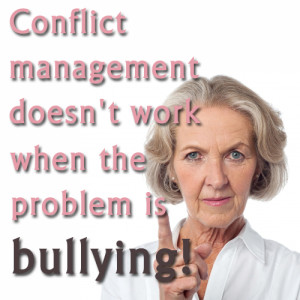
Bullying also can’t be fixed with conflict resolution because what is happening isn’t a “conflict.” It’s bullying. Sure, the person who is being bullied might respond to the bullying by entering into a conflict with their bully. But the underlying problem is that one person is behaving inappropriately (which is why it’s bullying and not conflict) and that bullying/harassment behavior is setting of a chain reaction of bad behavior between them and their victim. Conflict resolution assumes that both sides are equally guilty. But in a bullying situation, one side is to blame and the other is responding however poorly to that bad behavior.  Conflict resolution exacerbates bullying/harassment situations so it’s critical to understand when to use conflict resolution and when not to.

I gave a talk to a group of coaches a few weeks ago and we discussed this very dilemma. For me, I don’t consider using conflict resolution until both parties are behaving civilly. Because let’s be clear. Disagreements aren’t a problem. They are to be expected in normal human interactions. It’s how we respond to those disagreements that matters. If we respond civilly, there is no problem. There is only a problem if one or both parties responds by behaving badly.

My first task is to get the parties involve behaving civilly. Only after they start behaving properly and eliminate the bad behavior (whether it is passive aggressive or outright bullying), can we consider conflict resolution.

Always deal with the inappropriate behavior first. Don’t allow people who are behaving inappropriately to get away with it under the guise of conflict. If they really are in conflict fine. You can deal with their conflict, but only if they start behaving like the professionals they are. Conflicts are no excuse to behave uncivilly.

People who are capable of being civil, will try being civil and will work with you to resolve the problem. People who aren’t, because they have passive aggressive control issues or because they are chronic and habitual bullies, won’t behave civilly because they don’t know how and this will tell you pretty much everything you need to know about what is really going on.

To learn more about why conflict resolution doesn’t work when the problem is bullying, check out this course: https://humanistlearning.com/conflictresolution/ (HRCI/SHRM approved)


Navigating Minefields in the Office

Not every workplace has a toxic employee – but even non-toxic workplaces have their challenges.

If the Workplace Bullying Institute’s numbers are correct, then 48% of us have either been bullied, are currently being bullied or have witnessed bullying in the workplace. (see: http://workplacebullying.org/multi/pdf/WBI-2014-US-Survey.pdf) That’s half of the workforce. That’s a lot.

And for those of us lucky enough to not work in a workplace where that happens, we still have to deal with interpersonal dynamics. Even if we do get along, conflicts between people happen.

How can we navigate the potential minefields that exist in every office? Reason, compassion and action. The hallmarks of the humanist approach to life (see:  http://happiness.jen-hancock.com/)

In my career, I have dealt successfully with toxic people, annoying people, passive aggressive people and I’ve even survived a coordinated attempt to attack my character and get me fired, successfully.

I’ve survived all of these things because a) I’m a good person who is honest and conscientious. b) I own up to and correct my mistakes quickly. And c) I apply my reason and compassion to the problem to develop a strategy that will help me succeed despite what is being thrown at me.

Is it easy? No. Whenever these things happen, they catch me off guard like they do all of us. Most people are nice. Most of us just want to get our work done and do it well. People who are walking time bombs of insecurity are not the norm. It’s upsetting to become targeted by these people. The only thing worse than being targeted, is to be a walking time bomb of insecurity. I feel sorry for them.

By considering them compassionately, I resist the urge to demonize them. Not only can I treat them with respect, even if they fail to respect me, I can also often defuse the problem by using my reason to solve our collective problem because I’m not so upset or angry that I behave immorally in response to them.

While fighting back or defending yourself may feel emotionally satisfying, it does more harm than good. Behaving morally and ethically and conscientiously means I’m not adding to the problem. I’m just trying to get my work done and get along as best I can with other people. If I make a mistake, I correct it. I don’t blame anyone else. This is why it has been easy for all of my managers to see that I’m not the problem. I’m not!

Navigating the minefields of the office is hard, but you don’t need to tip toe around people who are just waiting to go off. You don’t serve your company or your coworkers well by avoiding them. Do your job. Do it well and be nice to everyone, including the jerks. If someone is intentionally making it hard to get work done document that fact. If they want to dig their own hole, you can’t stop them. But you can provide proof that they are the ones who dug the hole.

If you need help dealing with anger in yourself and others – consider taking this course by Dr. Leon Seltzer - https://humanistlearning.com/angermanagement101/

How to talk to people as if they were human

3 tips to improve your interpersonal communications


The problem with being human is that we are pretty much stuck inside our own heads.  From our point of view, the world kind of revolves around us.  All interactions we experience involve us. When people talk to us, we are experiencing only our emotions and how the other person makes us feel. We may be intellectually aware of the other person’s emotions, but what concerns us most, is our own response to what is going on.

This self-centeredness interferes with interpersonal communications and relationships. Why? Because it causes us to misinterpret and misunderstand what the other person is really trying to communicate.  So here are 3 tips to help you improve your interpersonal communications by helping you learn to talk to the other person as if they were actually human.

1) Respect – the other person isn’t you. They are them. Respect their individuality and autonomy.  You don’t know exactly what they are experiencing or why they are experiencing it. If they are emotional, it may be about you, but it may not. Don’t assume you know. They may have had a bad day or gotten bad news. Don’t assume they are reacting to what you are reacting to because they aren’t. They are living in their own little world and if you respect that, you will respect them and you will improve your communications and relationships because people like to be respected. And no, this isn’t something you can fake.


2) Step Back – accept that your understanding of what is going on is flawed. You are experiencing the communication from your point of view. They are experiencing it from their point of view. It is possible to consciously step back from your point of view to actively consider the other person’s point of view. And a rather “magical” thing happens when you do that. You come to understand the other person better and the other person is more likely to feel “heard.” This will again, improve your communications and interpersonal relationships.


3) Compassion – if things are tense, accept that they are. That doesn't mean you have to be tense. In fact, if one person in a conflict de-escalates, it improves the chances that the other person will as well. So, if you find yourself getting angry, have compassion for yourself and remember, it’s OK to be angry. But will that serve you well right now? Probably not. Make a conscious choice to not be the center of the universe for a short period of time and extend your compassion to the other person. This usually helps defuse and de-escalate things, which will work to your advantage. And if it doesn't de-escalate them, because they are so wound up they can’t calm down, you won’t be part of the problem.

Related Posts Plugin for WordPress, Blogger...