Showing posts with label freethought. Show all posts

False Dichotomies

 I've been chatting online with a rather smart individual who has been wanting to understand humanism and is asking me Socratic questions to try and understand it better.  The problem, he keeps posing things as false dichotomies.
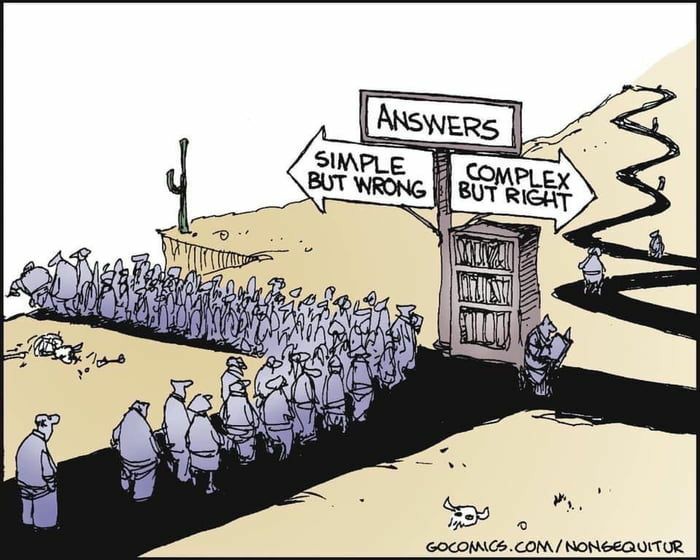
So, let's start by understanding what a dichotomy and a false dichotomy are. Then discuss why I as a Humanist balk at them so much.

A dichotomy - is "a division or contrast between two things that are or are represented as being opposed or entirely different."   According to wikipedia - A false dilemma, also referred to as false dichotomy or false binary, is an informal fallacy based on a premise that erroneously limits what options are available. The source of the fallacy lies not in an invalid form of inference but in a false premise. This premise has the form of a disjunctive claim: it asserts that one among a number of alternatives must be true. This disjunction is problematic because it oversimplifies the choice by excluding viable alternatives, presenting the viewer with only two absolute choices when in fact, there could be many.

An example of this when discussing humanism might be asserting that either communalism or individualism is the key to understanding Humanism. That's a false choice. We can do both. Neither. Something else entirely.

Part of free thinking as a practice is to free your mind to think of other choices. That is how we creatively get out of problems and solve them.

Often, the choice is both and. It's not either or, its both and.  In the example above, Humanism as a philosophy is concerned about both the individual and the community in which the individual lives. Humans are autonomous individuals embedded in society. We are dependent on society for our well being. To create flourishing, requires balancing the needs of the individuals within the community with the needs of the community itself. Where that balance best lies is a matter of vigorous debate. And it's a debate totally worth having.  

Why do I balk at false dichotomies? They cut off the debate. They assert it must be either one or the other and any choice made will be simple, but wrong.  I don't know what the right and best answer is. We may need to experiment, but what I do know is that choosing one extreme or the other will probably lead to unnecessary suffering and that's unacceptable.

Situational Ethics

And, like all things, the idea that all dichotomies are false is itself false. Sometimes, we have enough experience to know something is just wrong and harmful and no longer need to entertain it. Trickle down economics is one such thing. Nationalism is another. Supremacy of any kind is another. We don't have to weigh the good and bad and figure out how to integrate any form of supremacy into our solution. Doing so - even a little bit will cause more harm than good and we know this through experience.

So - looking for other answers that integrate both extremes is often a good strategy - but sometimes it's an insanely bad strategy which is why the situation and the specifics matter. If you try to integrate something that is demonstrably false, you will have problems.  

Nuanced

Which is why nuanced thinking is good thinking. To know whether you should try to integrate or not - you first need to think of the likely pros and cons. And we use humanist ethics to help us think of the pros and cons.  Does the solution help or hurt humans in general and in specific cases.

Nationalism and supremacy may help certain individuals but they actively and aggressively harm many others to do so - so it's rejected.

Compare that with a discussion on where to find the right balance between community and individual.  There are benefits and problems with both approaches. And it's possible to discuss how to find balance between the 2. Every nation and culture you look at finds the balance point in different places. There is no right answer to the question of how to balance individual rights vs community responsibility. 

There is definitely a wrong answer though. In places that are out of balance - where they go to an extreme - either extreme individualism or extreme communalism - suffering is always the result. Always. 

Nationalism is problematic because it's an extreme form of communalism. Supremacy is problematic because it marries extreme individualism with extreme communalism.  These view points are extremist because they are predicated on a false either or scenario. Either you dominate or are dominated.  A humanist knows those aren't our only 2 options.

Conclusion.

The questions this new contact is asking are interesting and thought provoking but also annoying because everything is posed in the form of a false dichotomy so I'm endlessly saying - it's not either or.  Environmentalism? It's not  - we do nothing or we go to an environmental extreme. We can transition and use our intelligence to solve our problems, but only if we don't shut off debate by insisting we either do nothing or we make things worse, which is how the right shuts off debate on climate. Heck - I'm in Florida - we aren't even legally allowed to discuss climate change. The words are banned in all government documents. It's silly and harmful. 

Don't fall into a false dichotomy trap. Recognize when yo are being given false choices. 


How to stay positive despite the horrors

A post for freethinkers, Humanists and atheists who are concerned about or dealing with violent oppression for their world view.

This is based on a question I got over at my Bollywood Humanist youtube channel. Queen movie Review: Bollywood/Kangana

Question:

I am a Humanist myself, nice to see your review. Specially incidents of the world now make me feel sad. Recently Saudi Arabia order beheading an Atheist. Similar punishment for Blasphemy was also there in Iran, Pakistan, Indonesia and other country.  Being a Bengali and Bengal is divided by British into Hindu and Muslim ( West Bengal and Bangladesh now) parts. Hindu Part fall into India and Bangladesh was under Pakistan then they fought for a secular country and make Bangladesh. We Bengali's from both side of the border share same language, culture, book, foods and also writer and bloggers. 18 writer, bloggers, cartoonist, publishers and were killed just because they were Humanist and spreading their message in Bangladesh, by ISIS. Hack to death in streets between 2015 to 2016. In India 3 humanist were killed recently H Farook was killed for posting "No God No God No God" in his Facebook status in Tamil Nadu.

We also see the rise of Right wing like Trump in USA, British, India now right wing leaders like Yogi Adityanath who previously openly used hate and threatening speech to all Muslims are elected in India. There were Hindu terrorist who are killing people for selling or consuming beef ( Cow is considered sacred among many Hindus).

Other secular country like Turkey becoming more of a dictator, arresting Atheist and Human Right activist. Saudi Arabia will be head of UN from 2018 ... I am not feeling good the direction the World and World politics are moving towards. What you thing and how we can promote human rights and harmony when hate and divide in the society is increasing ( as my observation).

My response:

Yes - it's a scary time and the entire freethought community is upset about the killings happening in the Bengal areas.  And yes, religious authoritarianism is on the rise in many places.   The good news is that there is resistance to that everywhere and we just have to keep resisting and finding positive ways to talk about life and be alive.  

I have been wavering between hope and despair for months now, but I keep finding reasons to be hopeful. For instance, Republicans in the US partnered with Dems to pass a budget that rebuffed the worst of what Trump proposed.  I am dividing my time between acts of resistance and acts of creation.  In times of great turmoil - creating beauty is in itself an act of resistance. One of the best lessons on this was the Velvet Revolution in Czechoslovakia. People realized that as oppressive as the state was - they operated mostly on fear. People were afraid to resist because of the threat of retaliation. But the artists involved in the Velvet Revolution created box art that could be shared and they decided to act as if the state couldn't find them - which they couldn't - not really. They resisted through art.

One of the reasons I wanted to review movies from a Humanist perspective was to highlight the work artists are doing to promote humanism and human rights even in the midst of societies that are doing their best to suppress dissent.

The other thing that keeps me hopeful is that a futurist/humanist I saw talk years ago said that religious fundamentalism/extremism would peak in 2014.  We are in the peak right now.  If we can resist and maintain positive pressure - we should be able to get through this despite the setbacks.
One way to understand the violent backlash against humanism and humanists is that this is part of the extinction process. Old ways of being never go quietly into the night. They fight back to regain supremacy. If they lose, they fight back harder and harder.  If they were winning, they wouldn’t need to fight. This violence is part of the behavioral extinction process.

On the other hand, there will always be people fearful of change and what it will mean for them and they will always be willing to fight for their truth. So even as society becomes less violent, and it has been getting less violent, there will always be people who agitate for violent change and for that, we have to remain vigilant. Which brings me back to the need to resist beautifully.

Proxy Problems


How much time do you spend on proxy problems?


I’ve been thinking a lot lately about proxy problems. These are the problems we spend our time solving that don’t really fix anything, because they aren’t really our real problem. They are our proxy problems that we try to solve because we think they will solve our real problem.

For instance, if you have a field that needs water, the easiest way to get water on it is for it to rain. If it doesn’t rain you have a problem because you need to now find a new way to get water on your field. A lot of people respond to this sort of problem by trying to fix the old way of solving their problem. If it isn’t raining, what can they do to make it rain. Trying to make it rain is a proxy problem precisely because the real problem is that you need water on your field.

The problem with proxy problems is that they take away time, energy and resources that could have been spent on actually solving your problems and focus those resources on solving the proxy problem and that normally doesn’t turn out too well because, well, you can’t make it rain. You can, however, find other ways to get water on your field.

Effective problem solving is all about figuring out what your real problem is so that you don’t spend time trying to solve your proxy problems. Everyone falls prey to proxy problems so don’t think that just because you are smart and read my blog that you are immune. We all waste time on proxy problems.

This is why Humanists are so fond of Freethought. It isn’t that we use it to reject religion. It’s that we use it to challenge our own assumptions about what our real problems are so that we don’t waste time on proxy problems.

The biggest skill required for Freethought is humility. Humility to admit you were wrong so that when you do figure out you’ve been focused on a proxy problem, you stop working on it and focus on the real problem you are trying to fix instead. A good example of this is Martin Pribble recent rant – I Quit. http://martinspribble.com/2013/12/a-rant-i-quit/

Time to fess up, what proxy problem have you wasted an amazing amount of time on before realizing it was a proxy problem?


What are people afraid of?


Want to know what motivates someone - learn what they are afraid of.


Dealing with a difficult interpersonal issue?  Have no clue why someone is behaving the way they are?  Are they crazy? Perhaps. But it’s more likely that they are just scared.

Consider how you behave when you are afraid of something? Are you at your most rational best when you are afraid? Of course not.  To people who don’t share your fear, you seem a bit crazy.

So the next time you find yourself wondering why someone is behaving the way they do, find out what they are afraid of. Not to use that to manipulate them. But in a compassionate way so you can understand them and help them and by helping them, help yourself.

You may just find that the more you practice compassion towards others, considering their fears as the reasons for their motivations, the more you understand how your fears impact your own behavior.

When you can see your own fears more clearly, they impact you less and you are influenced by them less. Humanism is a personal practice. Compassion for others is a personal practice. Yes, you are considering others compassionately, but by doing so, you often find more compassion for yourself.

Charles Darwin was right


Not just about evolution, but about anti-theism as well.

I am a Humanist and as a Humanist, I value Freethought on all subjects: including religion. We Freethinkers know no taboo.

However, you will also notice that I rarely write or speak about religion, focusing instead on how we all can use the tools of Freethought and critical thinking and compassion based ethics to lead better more ethical lives of personal fulfillment that aspire to the greater good of humanity.  

I take this approach because I know the benefits of this approach aren’t just for the non-religious. Everyone can benefit even if they don’t make full use of the tools. 

I am on occasion asked why I don’t take a more anti-theist approach. The quick reason is because I’m not an anti-theist. I’m a Humanist. I honestly don’t care what other people believe or don’t. I care whether they are a good person.  The other reason is because I don’t see that debates about belief or not belief do any good. I see them cause conflict, but not much learning.

On this subject, I am going to defer to Charles Darwin who said, 
“I am a strong advocate for free thought on all subjects, yet it appears to me (whether rightly or wrongly) that direct arguments against Christianity & theism produce hardly any effect on the public; freedom of thought is best promoted by the gradual illumination of men's minds, which follow[s] from the advance of science. It has, therefore, been always my object to avoid writing on religion, I have confined myself to science. I may, however, have been unduly biased by the pain which it would give some members of my family, if I aided in any way direct attacks on religion.”
— Charles Darwin

On these matters I agree with Charles Darwin. 


Thought Holes and the Value of Freethought


How to overcome adversity with critical thinking.


There is a great article over at edutopia on thought holes - http://www.edutopia.org/blog/SEL-filling-in-thought-holes-renee-jain

What I like about it is that it is actually a lesson in critical and creative thinking. Basically, the article talks about how our perception of reality is distorted and how those distortions affect our moods, thoughts, actions etc. If we have a negative distortion that we believe is true, even when it isn’t, it can cause us to do stupid things and that would be bad.

The article then goes on to identify 8 common thought holes or distortions and suggests correcting them by doing 3 Cs:

• Checking to see if you have entered a thought hole

• Collecting evidences to see if it is a thought hole and if it is

• Challenging your original thoughts

I am a Humanist and Humanists engage in freethought. Freethought is a way to challenge our thinking because our thinking is biased and it can cause us to make mistakes. By actively checking and challenging your thoughts and testing them against reality, you can avoid mistakes. And that’s always a good thing. This is why Humanists are always going on and on about the necessity of critical thinking and freethought.

The good news is that doing this works. It works really well. Check to see if you made a mistake in your thinking; collect evidence to verify whether you have or not and if you have, challenge the incorrect thoughts and replace them with more accurate ones. That’s pretty much freethought in a nutshell.

The next time you start thinking that you aren’t good enough and that no one likes you so you might as well go eat some worms, think again. You may just find that the adversity you were working so hard to overcome didn’t really exist in the first place.

Question: Which of the fallacy (ie: thought holes) do you fall prey to most often? Personally, I tend to mentally filter.


Getting rid of nagging thoughts

How critical thinking skills can help you focus and not fret.


Nagging thoughts plague everyone. The problem is that they are rarely productive. They prevent us from thinking about the things we should be. Why? Because our minds aren’t always under our full control.

The way I get rid of nagging thoughts and anxiety is to address them. What am I afraid of? What can I do to avoid that? As soon as I have a plan to deal with the possible negative consequences, my brain relaxes and allows me to move forward with what I was supposed to be doing. This works every time and it’s very easy to do.   I have another blog post on why Proper Planning is Not Pessimistic, if you want to learn more (http://humanisthappiness.blogspot.com/2012/08/proper-planning-is-not-pessimistic.html)

Interestingly enough, the skill of questioning yourself and your motives is an essential aspect of critical thinking and freethought. Humanists practice them because they help us solve our problems, even if our problems exist only in our imaginations.

This rational approach to dealing with managing anxiety and worry only works if you have otherwise normal brain functions. If you are suffering from OCD, this won’t work.  OCD has a very strong genetic component and it is considered a disorder. Meaning people suffering from it aren’t able to control it without assistance from a professional. If you have OCD or suspect you might, talk to your doctor and seek professional help. You will be glad you did. Admitting your problem is beyond your ability to control is actually a relief as it puts you in a position to finally get your problem under control.

For everyone else – practice critical thinking. It really does help manage anxiety and worry rather well.

I’m curious to know what other people do to manage their nagging thoughts. Do you have a system that works well for you? If you do, please please share!

Everything will be alright


Why clearing the mind of clutter is so essential to progress.


There is a common thread that runs through the writings of activists across the globe. And that is that before they could really take on the root cause of the problems they were facing, they first had to free their own minds and decide for themselves what was right and what was wrong outside of what the social, religious or cultural norms were.

It is surprisingly hard to do. Most people are able to challenge only a portion of their preconceived notions and so their focus of change is narrow. Those who succeed often become great agents of change because they see how all the various forms of discrimination are interrelated. Discrimination comes from the same place even if the target is different.

Humanism and Freethought help clear the clutter out of our minds. But not everyone is willing to clear out everything. They are rightly concerned about being left adrift. After all, once you clear away the clutter, you usually go back and put some of the old stuff back in because, as it turns out, it was useful.

Many people approach self-reflection fearfully. A Humanist makes self-reflection a habit of the mind. We are continually challenging our assumptions. Our goal is to continue to improve ourselves and the world we live in. The benefits of clearing out the clutter of our minds are so great; we can’t imagine living life any other way. 

How do we nurture Freethought and clearing the mind, even if it is on a small scale? How can we reassure people who need to take this journey that it will be ok and that they will emerge on the other side of this stronger and more centered as a human being?

Freethought Music

Yes - there is such a genre as Freethought music. And it transcends genres. Here is a list of Freethought artists I am familiar with. If you know of others, please add them to the list. You can sample each artist’s music on their website.

Markella - former opera star turned Freethought recording artist. http://www.markella.com/ 

Freethought MC - MC stands for Man of Conscious, he creates hip hop music and is in the studio working on his next album - http://www.reverbnation.com/freethoughtmc 

Peace of Rock - poetic rock music from and for free minds - http://peaceofrock.net/ 

Johnny Hoax - Atheist Rapper - http://www.reverbnation.com/johnnyhoax 

Also - here are some other Freethought music and entertainment resources you might like to know about.

Keith Lowell Johnson - Atheist comedian - very funny - http://keithlowelljensen.blogspot.com/ 

Inspirational Humanist Radio Hour - an hour long show out of NY. Airs Tuesday nights at 10 pm but available on podcast as well - great music and musings. - http://www.radiohive.org/category/shows/ihrh 

As I said - these are just a few artists I know about. If you know of others, please let me know!

Arrogant Atheists

I realize this is a blog about Humanism, and Atheism isn’t part of my normal repertoire. But trust me, there is a point to all this. This post is actually written for people of faith trying to make sense of the apparent arrogance of “new” atheists, meaning people who have only recently come to their atheism as opposed to old hands like me. What you need to know is that most of them aren’t trying to be arrogant. What they are trying to be, believe it or not, is helpful.

I think we can all agree that the closer your understanding of how the universe works is to how it actually works the easier the time you will have navigating your way through it. What is happening with the “new” atheists is that they have recently experienced a dramatic change in how they think the universe works and this change in understanding has made their lives not just easier, but A LOT easier. And when you experience something that is not only that dramatic, but that is also incredibly effective at improving your life in general, well, it’s REALLY hard to keep that new knowledge to yourself.

One of the powerful new techniques that “new” Atheists learned on their journey was the discipline of Freethought. Humanists also practice Freethought and regardless of belief or unbelief, there is no reason you shouldn’t as well. I have an entire chapter dedicated to this topic in my book. Here’s part of the concluding paragraph of that chapter:
“A word of warning: once you begin to practice Freethought, you will wonder how you ever made reasonable decisions before. …This newfound knowledge of the tangible benefits of Freethought will probably make you less patient with those who do not practice the technique. Just remember, a little compassion goes a long way."
Conclusion: Most “new” atheists aren’t being arrogant; they are just being a bit inarticulate in their excitement. Be patient with them.
Related Posts Plugin for WordPress, Blogger...