Showing posts with label debate. Show all posts

False Dichotomies

 I've been chatting online with a rather smart individual who has been wanting to understand humanism and is asking me Socratic questions to try and understand it better.  The problem, he keeps posing things as false dichotomies.
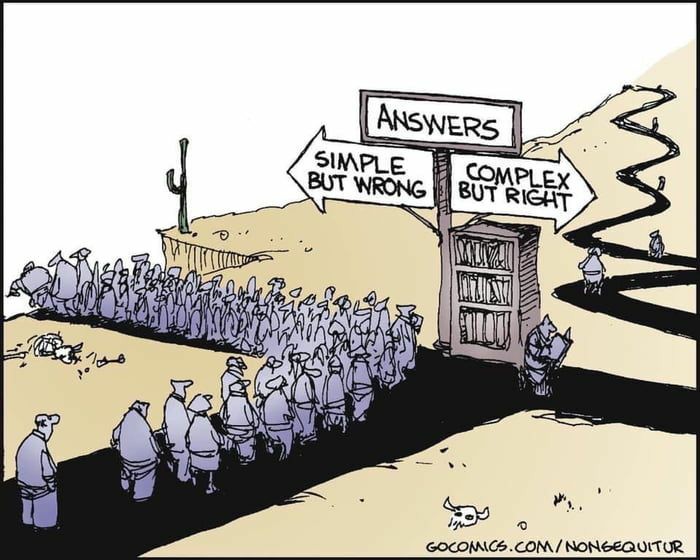
So, let's start by understanding what a dichotomy and a false dichotomy are. Then discuss why I as a Humanist balk at them so much.

A dichotomy - is "a division or contrast between two things that are or are represented as being opposed or entirely different."   According to wikipedia - A false dilemma, also referred to as false dichotomy or false binary, is an informal fallacy based on a premise that erroneously limits what options are available. The source of the fallacy lies not in an invalid form of inference but in a false premise. This premise has the form of a disjunctive claim: it asserts that one among a number of alternatives must be true. This disjunction is problematic because it oversimplifies the choice by excluding viable alternatives, presenting the viewer with only two absolute choices when in fact, there could be many.

An example of this when discussing humanism might be asserting that either communalism or individualism is the key to understanding Humanism. That's a false choice. We can do both. Neither. Something else entirely.

Part of free thinking as a practice is to free your mind to think of other choices. That is how we creatively get out of problems and solve them.

Often, the choice is both and. It's not either or, its both and.  In the example above, Humanism as a philosophy is concerned about both the individual and the community in which the individual lives. Humans are autonomous individuals embedded in society. We are dependent on society for our well being. To create flourishing, requires balancing the needs of the individuals within the community with the needs of the community itself. Where that balance best lies is a matter of vigorous debate. And it's a debate totally worth having.  

Why do I balk at false dichotomies? They cut off the debate. They assert it must be either one or the other and any choice made will be simple, but wrong.  I don't know what the right and best answer is. We may need to experiment, but what I do know is that choosing one extreme or the other will probably lead to unnecessary suffering and that's unacceptable.

Situational Ethics

And, like all things, the idea that all dichotomies are false is itself false. Sometimes, we have enough experience to know something is just wrong and harmful and no longer need to entertain it. Trickle down economics is one such thing. Nationalism is another. Supremacy of any kind is another. We don't have to weigh the good and bad and figure out how to integrate any form of supremacy into our solution. Doing so - even a little bit will cause more harm than good and we know this through experience.

So - looking for other answers that integrate both extremes is often a good strategy - but sometimes it's an insanely bad strategy which is why the situation and the specifics matter. If you try to integrate something that is demonstrably false, you will have problems.  

Nuanced

Which is why nuanced thinking is good thinking. To know whether you should try to integrate or not - you first need to think of the likely pros and cons. And we use humanist ethics to help us think of the pros and cons.  Does the solution help or hurt humans in general and in specific cases.

Nationalism and supremacy may help certain individuals but they actively and aggressively harm many others to do so - so it's rejected.

Compare that with a discussion on where to find the right balance between community and individual.  There are benefits and problems with both approaches. And it's possible to discuss how to find balance between the 2. Every nation and culture you look at finds the balance point in different places. There is no right answer to the question of how to balance individual rights vs community responsibility. 

There is definitely a wrong answer though. In places that are out of balance - where they go to an extreme - either extreme individualism or extreme communalism - suffering is always the result. Always. 

Nationalism is problematic because it's an extreme form of communalism. Supremacy is problematic because it marries extreme individualism with extreme communalism.  These view points are extremist because they are predicated on a false either or scenario. Either you dominate or are dominated.  A humanist knows those aren't our only 2 options.

Conclusion.

The questions this new contact is asking are interesting and thought provoking but also annoying because everything is posed in the form of a false dichotomy so I'm endlessly saying - it's not either or.  Environmentalism? It's not  - we do nothing or we go to an environmental extreme. We can transition and use our intelligence to solve our problems, but only if we don't shut off debate by insisting we either do nothing or we make things worse, which is how the right shuts off debate on climate. Heck - I'm in Florida - we aren't even legally allowed to discuss climate change. The words are banned in all government documents. It's silly and harmful. 

Don't fall into a false dichotomy trap. Recognize when yo are being given false choices. 


Strengthening Humanism

Debates about the limits of Humanism and how to strengthen Humanism


I have been volunteering with the International Humanistic Management Association (http://humanisticmanagement.international/).  At our recent meeting in NYC - I had the pleasure of meeting Chris Laszlo of the Weatherhead School of Management (https://weatherhead.case.edu/faculty/chris-laszlo).

He and I both recently published books. Mine on Applied Humanism (https://amzn.to/32GLbba) and him on Quantum Leadership (https://amzn.to/32IeJVT)

He gave me a really lovely review that included a critique of humanistic management. "I just finished reading your new book, Applied Humanism. I loved its clarity and straightforwardness. In many ways the writing is deceptively simple: the concepts and their applications are universal in appeal yet subtle in their implications for living and working in today’s world. Although I remain skeptical about some aspects, such as the reliance on what appears to be largely western science (physicalist, positivism) and the rejection of mysticism and spirituality, I learned a lot. In case of interest to you, I’m attaching a recent article that highlights what I see as some limitations of humanistic management."

Here is a link to his article: https://link.springer.com/article/10.1007%2Fs41463-019-00055-9

The article discusses what he likes about humanistic management and what he thinks the limitations are.  These include the idea that Humanism is a form of species-ism, That we need to move beyond the dichotomy of economistic vs. humanistic thinking in business and that Humanism is reductionist (ie: too much of a reliance on science as opposed to other ways of knowing).

As this is similar to a recent post I had about how debates about Humanism are rarely actually debates about Humanism and are usually just discussions about what Humanism should ideally be (https://humanisthappiness.blogspot.com/2019/07/the-meaning-and-legacy-of-humanism.html) I thought I'd include my response to his concerns here.  He appreciated this and responded to me - which I will include at the end.  What follows is basically a conversation about the whats and whys of Humanism.

My response: 

Thanks for sharing your paper Chris.  I see nothing inconsistent with your ideas of quantum flourishing and a humanistic approach.   It easily encompasses your ideas without altering its basic nature.  To me – I read your article and thought – yes, of course.

Here is how I think of my practice as a Humanist – I was born a human. My goal is to be the best human I can be. Humanism is the applied study of what it means to be a good human being.  You have studied that too – and came up with your quantum leadership ideas – which are excellent.  

Your critiques of humanistic management are totally accurate. When you brought them up at the meeting I thought – he gets it. He’s one of us! He just doesn’t know it yet.

So – to respond to your critiques:

Humanism is not species centric. The name sounds like it would be – but it’s not. Science teaches us that Humans are a part of nature, not apart from nature.  The idea that Humanism implies humans vs the rest of the natural world is a dualistic idea that usually comes from religious thinking. It’s not a humanistic idea. Also – the idea that humanism is dualistic to religion – is dualistic and not realistic.

We can chat more about that if you like as I have done a lot of writing on this exact issue. The point is that humanists tend to reject dualistic thinking as inaccurate thinking.
  
Your formulation of Humanistic Business Management is opposed to Economistic views of business is, again, dualistic. And I dislike that formulation as simplistic and inaccurate precisely because it is dualistic. So again, my response was – yes – you are correct.
  
Was it Pascal that said, Man does not achieve greatness by being at one extreme or another, but by touching both at once. Another great quote is – the opposite of a great truth – is often – another great truth.  Either or, dichotomies are not good ways to think about things. It leads to dualistic thinking. And you are correct – that’s not a good way to think about things, which is why I know very few humanists who think in terms of dualism. It’s more universalistic.   To me – the economistic model – has value. It’s not so much wrong as it is incomplete. Adding humanism to it – helps fill in the missing bits and makes us less wrong. But, as you point out, all models are incomplete. Which is why you want to add on the quantum stuff. And you are correct to do so and doing so will improve the model and consequently – make it more humanistic. Your add on – is the epitome of what humanists do. We strive to be less wrong. I’m sharing a post I wrote about this based on writing by a fellow Humanist Isaac Asimov.  http://humanisthappiness.blogspot.com/2012/01/how-being-less-wrong-is-actually-right.html
  
Humanism has no dogma and will never have a final – this is the way things work There will never be a final statement about what Humanism is and how we view the universe. Why? Because Humanism is the applied study of what it means to be a good human being. As we learn more and are less wrong, of course we are going to change how we think about things and go about doing good. What would be crazy – would be to not adjust our thinking. Flexibility and openness to new knowledge IS the hallmark of a Humanist mindset.

Finally, Humanism isn’t reductionist in a scientific sense. I forget which Humanist manifesto it is in – but Humanists are as much informed by science as we are by the arts.  You are correct – a strictly scientific approach is insufficient for a wide variety of reasons – that go beyond what you identified. Though to the points you are making, there are really lovely debates about the limits of human agency – and what is called swerve (uncertainty and indeterminism at an atomistic/quantum level) - https://en.wikipedia.org/wiki/The_Swerve.

I suspect that these debates will never go away – probably because the debate between determinism and indeterminism is a dualistic debate and the answer is probably that both are correct. Not either or.  In other words, our behavior and choices are both conditioned and determined and also indeterminate and open to change through choice simultaneously.  And I LOVE discussing these concepts. They are absolutely central to the idea of Humanism – which is – that humans have agency

I think of this mostly in terms of humanistic psychology and behavioral psychology because that false dichotomy is central to my work on how to stop bullying and harassment using both behavioral and humanistic techniques. Most modern psychologists no longer accept the old dichotomy. It’s both and …  Both the humanists and the behaviorists were right and a more accurate model of human psychology and behavior – incorporates both – not either or. http://humanisthappiness.blogspot.com/2018/08/humanist-vs-behaviorist-dialectic.html

Anyway – thanks foryour essay – I really enjoyed reading it.  And it obviously got me thinking some pretty deep thoughts – which I really enjoy doing. It reminded me of conversations I had with Edgar Mitchell who founded the Institute for Noetic Sciences. He was such a lovely man. http://www.sumogirl.com/sumomambo/index.php?option=com_content&task=view&id=839&Itemid=62


Chris's Response:

Thanks for your thoughtful reply. Synchronicity: this coming week I’m going to the IONS 2019 annual meeting and will be speaking on a panel about Noetic Leadership.

Your points about the inclusiveness of the humanistic and quantum leadership perspectives are well taken. In many cases, dualism doesn’t serve us. But with quantum science and its ontological implications, it’s not so much about dualism as it is about a paradigm shift. In the history of science, as you point out, there have been successive paradigms such as the transformation from the Ptolemaic to the Copernican model. Thomas Kuhn’s idea of science as a succession of paradigms seems to me hugely relevant today. Humanity is on the cusp of a new understanding of reality, one in which noetic science—including mystical and spiritual ways of knowing—will be better integrated. Edgar Mitchell would have been thrilled 😊


Learning how to argue effectively

I was recently introduced to an online game that teachers logic and debate and more importantly the rules of debate and how to recognize valid and invalid arguments.


It's a pretty cool game to play and a neat way to learn debate techniques.  How to ask questions and get clarification so you can understand what is being said in a debate and what it means.

You will notice - it's a game that teaches you how to ask questions.  Not how to argue. And that's important because the skill of asking questions - good questions - is a good skill to learn. It's also how you learn to "win" arguments. 

You can play the game here for free - http://socratesjones.com/

Now - if you want to learn how to win a debate or how to win an argument - you need to take my online course on Socratic Jujitsu - https://humanistlearning.com/socratic-jujitsu/


The meaning and legacy of Humanism

Did you know there are debates about Humanism? What it is? Why it matters?  There is even apparently a high profile debate about the definition of Humanism that I was told really was important as it was influencing a lot of people.

I was not even aware this debate was happening. It certainly wasn't influencing me. And the people I influence and meet - never asked me for my take on it either. So in my corner of the world of Humanism, this debate was non-existent.

But I was given a link to the discussion - which is quite collegial. I read it - and I loved it! And am sharing the link here:

https://secularhumanism.org/2018/04/cont-the-meaning-and-legacy-of-humanism-a-sharp-challenge-from-a-potential/

Basically - a guy who I've quoted before in my recent post about free-will and Humanism - http://humanisthappiness.blogspot.com/2019/06/free-will-and-humanism.html  defined Humanism in a way that a philosopher who specialists in Humanism at Carnegie Mellon University didn't like.

When I read the debate - I found I agreed with both of them and that I thought they were talking past each other. Or rather, one of them refused to accept that the other was talking about.

Yuval Harari defines Humanism correctly. So does AP Norman. So - what gives? How can they both be right.

Humanism isn’t just the modern movement. It also refers to people who study the humanities and renaissance scholars etc.  This is an ongoing problem we are always going to have because we can’t change history. The term Humanism refers to a lot of different things.

It is usually enough to say – we are talking about movement Humanism (with a capital H) and not academic humanism (lower case h).

I also think Yuval’s critique of Humanism both capital H and lower case h is valid. Movement Humanism is constantly evolving for exactly the reasons Yuval points out. When we find out we made a mistake – we attempt to correct it.

It’s a great dialogue.   I don’t see why it should cause any fear that our movement is being maligned when he is doing the exact opposite.  Pointing out potential inadequacies.  The way I view these sorts of conversations is 2 fold. 

1 – when someone has these critiques – it means they are interested and aligned with the philosophy of Humanism (capital H) and are allies.  Like when people worry that Humanism is a form of speciesism.  They get it. And they are right to be worried about speciesism. I am too – as a Humanist.  We are aligned.  That gives us a basis for collaboration.

2 – the number of people engaged in this debate is super small.  Most of humanity is totally unaware it’s going on and are not influenced by it at all.  Instead of worrying about the small number of people who might get the wrong impression because they conflate humanism with Humanism, understand that Humanists will always have to distinguish ours philosophy from the other forms of humanism and that shouldn’t freak us out. We should instead welcome those conversations and use those other uses of humanism as a way to explain and educate people about how we practice our Humanist philosophy.

In other words, we should be focused on educating the masses instead of worry about an argument 10% of the population is attending to.

Scientific Literacy is a Basic Life Skill

What the vaccine debate can teach us about the importance of scientific literacy

On a parenting discussion board, one of the parents was discussing vaccines. She doesn't trust the government and so doesn't trust the government’s guidelines on vaccination schedules for her kid. And when presented with the evidence that the vaccination schedule is actually REALLY good and that kids and society benefit from vaccines she said this: “There are all kinds of studies that prove or disprove and it is hard to decide what to believe.”  In other words, in the face of evidence to the contrary – she is sticking to her decision.

I don’t want to get into a vaccine debate here. What I want to do is to debunk her comment that “there are all kinds of studies that prove or disprove and it is hard to decide what to believe,” because – that simply isn’t true. Anyone who is scientifically literate can figure out which studies to believe. It isn't actually all that hard to figure out which competing claims are reality based or not. It just takes a little effort to get the information and to see if there is any information debunking the claim.

Given the life or death nature implications of the vaccine debate it is clear that the scientific literacy required to judge whether any particular study is reality based or not should be considered a basic life skill.

Scientific Literacy

To figure out which competing claims are true and which are false requires a skill known as scientific literacy. Being scientifically literate is something you can learn if you make an effort to do so. To be scientifically literate means you know how to evaluate claims being made using basic science.

For instance, what constitutes a valid study? What do the statistics used in a study mean or don't mean? What constitutes a statistically significant finding? Scientific literacy also requires that you cultivate the critical thinking skills necessary so that you can recognize the most common logical fallacies and a few other thinking skills that involve overcoming personal biases in your own thinking.

Saying - it's so hard to figure it out - is a cop out. You are basically telling everyone that you are too lazy to think well and that you suffer from confirmation bias so you didn't bother to question a claim because you didn't want to have your opinions challenged by actual facts.

It's good this woman was willing to hear competing information, but having asked for that information she shouldn't have then claimed that it's too hard to figure out what is true and what isn't. It isn't too hard. You just have to put in a little effort. More if a claim confirms your personal biases as we all have our blinders.

To learn more about how to figure out if a claim is true or not – consider taking “Living Made Simpler – https://humanistlearning.com/livingmadesimpler1/

Charles Darwin was right


Not just about evolution, but about anti-theism as well.

I am a Humanist and as a Humanist, I value Freethought on all subjects: including religion. We Freethinkers know no taboo.

However, you will also notice that I rarely write or speak about religion, focusing instead on how we all can use the tools of Freethought and critical thinking and compassion based ethics to lead better more ethical lives of personal fulfillment that aspire to the greater good of humanity.  

I take this approach because I know the benefits of this approach aren’t just for the non-religious. Everyone can benefit even if they don’t make full use of the tools. 

I am on occasion asked why I don’t take a more anti-theist approach. The quick reason is because I’m not an anti-theist. I’m a Humanist. I honestly don’t care what other people believe or don’t. I care whether they are a good person.  The other reason is because I don’t see that debates about belief or not belief do any good. I see them cause conflict, but not much learning.

On this subject, I am going to defer to Charles Darwin who said, 
“I am a strong advocate for free thought on all subjects, yet it appears to me (whether rightly or wrongly) that direct arguments against Christianity & theism produce hardly any effect on the public; freedom of thought is best promoted by the gradual illumination of men's minds, which follow[s] from the advance of science. It has, therefore, been always my object to avoid writing on religion, I have confined myself to science. I may, however, have been unduly biased by the pain which it would give some members of my family, if I aided in any way direct attacks on religion.”
— Charles Darwin

On these matters I agree with Charles Darwin. 


To Accept Yet Dissuade


How to balance debate between understanding and disagreement so that learning actually takes place.


Humanists love to debate. It is an opportunity to flex our mind muscles and to learn and think more rigorously. When done right, debate is an opportunity for us to learn and to think different and to perhaps even change our minds.

All too often, debate is used as a tool of anger and frustration. This is especially true when the stakes are high as they are when we debate public policy. Instead of debate, what we get is arguments for and against that are not designed to enlighten but to persuade and win.  This is why so many people choose to demonize people who disagree with them.  It is easier to consider your debate opponent as inhumane than to concede they might have a valid point.

When discussing this difficulty in an online class I recently taught, one of the students, Phillip said the following, “To accept yet dissuade... Delicate politics I yet still learn! While I try to understand all it is sometimes difficult to know how others come to understand or exactly what background led to their beliefs.”

Despite my professed desire as a Humanist to not make assumptions about the motives of other people, I still fail at this at times. There is the ideal about how I should act and the reality of how I do when challenged or frustrated. The question is how we can respond to disagreement in a way that is consistent with our ideals. How can we habitualize rational debate and disagreement without letting our egos get the better of us?

Personal experience and research shows us that understanding and accepting that the person you disagree with has reasons for holding the views they do helps us focus on them as individuals rather than on the points they are trying to make. The benefit to this approach is that it helps us focus on the real problem this person is concerned with as opposed to the superficial issues they are actually debating. When we make it our responsibility to find out what those reasons are, we at least fulfill our obligation to learn from debate even if our opponent does not.

Accepting that you can’t force people to change their minds, allow you to focus on whether or not you are learning from the debate as you should be.

Do you have any stories about a debate or disagreement that changed the tone and nature of the debate simply because you stepped back from your ego? Please share if you do.

Don't Label Me Dude

One of the things I like about Humanism is that it encourages us to respect every person we meet as the individuals they are. Which to me means don't assume you know who a person is just because of some assumed affiliation you think they hold.  When you do that you generalize. And besides, we all know what happens when we make assumptions. We not only make an ass out of ourselves, we are usually wrong.

I bring this up because on Google+ I was just accused by a guy I don't know of equating Humanism with Atheism. For those of you who know me and have read my book, seen my videos or heard me talk, you know that is something I have NEVER done. In fact, I've written pretty extensively on the fact they aren't the same thing.  He just assumed that because I am a vocal Humanist that I equate Humanism with Atheism. As it turns out he has just published a book on Humanism, considers himself a Humanist, and feels like I do about the atheism issue. I am not going to link to his website though because the guy made such an annoying first impression on me by assuming I think things I clearly don't.

The point is that you should never assume to know what someone else thinks. And, if you claim to be a Humanist, you should probably:

A) Try applying your Humanist values of respecting the fact that people are in fact individuals to the people you actually meet. In other words, don't label them dude.

B) Get your facts straight. This guy didn't bother to find out if what he thought was even true. Which means he didn't bother to challenge his own assumptions which led him to make an ass out of himself when it turned out his rather angry and snarky comments to me were unfounded.

C) Don't assume you disagree with someone you've never met. Find out if you do first. And most of all, allow people to surprise you with just how wonderful they really are. 

Religious Tolerance 101

So, today I responded to a youtube question about why Atheists ridicule people of faith. It is a good question, because let’s face it, everyone believes something different and some of us don’t believe any of it at all. And despite that we still all need to get along.

Religious tolerance isn’t easy. It means accepting people for the good people they are despite the fact they believe something that probably seems absolutely absurd to you. And then they need to reciprocate that acceptance of you despite your differences. It isn’t that hard to do, you just need to be respectful of the fact that very good moral people can believe very different things and that is ok as long as they are good moral people.

If you sincerely like someone you will respect their beliefs regardless of how ridiculous those beliefs seem to you. If you don’t you won’t. It is as simple as that. And I can say from experience, the ONLY times I get snarky about faith is when I am pushed to that point by someone who isn’t respecting my disbelief. If you are nice to me despite the fact I don’t believe as you do, I will be nice to you to. It really is that simple.
Related Posts Plugin for WordPress, Blogger...