Showing posts with label knowledge. Show all posts

In Flatland, you are the square

True knowledge is understanding that YOU are the square in Flatland.  And that the Sphere was ALSO, the square.
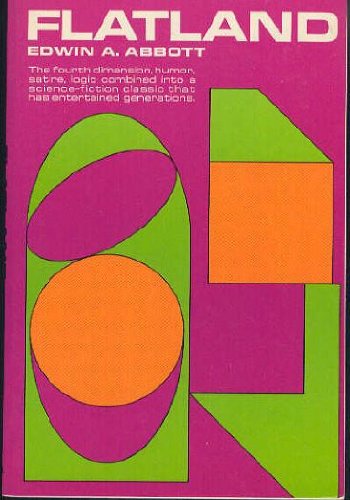

If you have not read this book, you absolutely should. It's a short fable designed to help us expand our thinking and be humble at the same time. https://amzn.to/3soTKmS

The book came up in a discussion between Julia Galef and Jonathon Haidt during the Rationally Speaking podcast. http://rationallyspeakingpodcast.org/show/episode-252-understanding-moral-disagreements-jonathan-haidt.html

Transcript here: http://static1.1.sqspcdn.com/static/f/468275/28405589/1613677458480/rs252transcript.pdf

The conversation was actually about understanding different people's moral framework. Haidt talks about our moral sense and uses the metaphor of taste buds. There are basic flavors we can all taste and all tastes are actually a combination of those core tastes. 

He argues it is the same with morality. There are core evolutionary responses we have and all our moral depths and dimensions is actually the blending of these cores. It is why we can feel happy and sad at the same time.  The movie Inside Out does a great job of explaining this. 

Anyhoo, back to Flatland. For those who have not read it, it's about a 2 dimensional square that encounters a 3 dimensional sphere. The 2 dimensional square cannot comprehend the sphere as he has no ability to experience 3 dimensions. The book is about the square learning about 3 dimensions and coming to terms with learning about what he didn't know before. (and yes, the square is gendered male - hence the pronoun use).

The square begins to understand that a 1 dimensional behind can't experience him as 2 dimensions either because all it will experience a square as it passes through a line is as a point.  The square experiences the sphere as a circle that changes sizes as it passes through the 2 d plane.  And yes, this book is mathematically geeky.

We are the square. We all don't know what we don't know and how we experience others is our impression of them on us, not the reality of them. 

Where the true knowledge comes in is when the square starts asking the sphere about 4 d space and 5 d space. And the sphere refuses to consider it. The sphere experiences and has knowledge of 3 dimensions. It cannot comprehend a fourth. 

But the square, now that is knows about the 3rd dimension and accepts it as reality, can now imagine a 4th and 5th to the nth degree.

Thus, the sphere, becomes like the square when we first encounter him. 

We are all simultaneously aware and unaware. Knowing this allows us to be humble, and open to learn. 


We need knowledge and caring and sharing

I came across this video by Vandana Shiva - a physicist and thinker the other day. She talks about the importance of knowledge and caring and sharing as a way of life, that impacts - everything. Businesses, interpersonal relationships, life on earth - everything.

It's a very articulate statement of the humanistic mindset. Check it out.


Continuing Education.

Why a commitment to your continued education will help you personally and professionally.


Knowledge is power.  It represents liberation. Without knowledge you can be taken advantage of and duped into doing things that are counterproductive. And the worst part is, you won’t even know it.

No one is perfect and there is always room for improvement. This is why Humanists are lifelong learners and advocates of continuing education in the form of personal and professional development.

Not all educational opportunities are alike. There is a tremendous amount of woo being peddled by self help gurus and life coaches. Woo is a derogatory term for non-science based nonsense peddled as knowledge.  All too often, people looking to improve themselves are led astray by peddlers of woo. This is why the self help movement has such a bad reputation. People are being taken advantage of by charlatans and they don’t even know it!

An example of woo is the positive thinking movement that is based on the book, The Secret. The idea that all you have to do is have faith and trust and a little bit of pixie dust and suddenly what you wish for will materialize is a nice thought, but it doesn’t work in the real world. Last time I checked, wishing didn’t work too well. If you want someone to send you a check in the mail, you have to do something to earn it.

Now, you may be wondering why I am picking on the positive thinking movement. It’s harmless right. And why not be positive? Well, that’s the problem with woo. It isn’t harmless. People spend money to learn the techniques. They spend time trying to solve their problems by thinking the right thoughts. They police their thoughts in an effort to think correctly. All of this is time, energy and money that isn’t being spent on fixing whatever problem you have. The worst part is that not only does this not work, you can’t get a refund! If you complain it didn’t work you will be told that it’s your fault. The coach or guru never has to issue a refund for teaching something that didn’t work. Sure it works for them. They may even be true believers. But they still suckered someone out of their money and then blamed them for their failure. That’s cruel and abusive, especially given the financial hardships people have faced recently.

It’s time to get real 


My point is that if you really want to improve you need to find teachers that will teach you reality based pragmatic approaches that will actually help you learn what you need to do to succeed. What you need is practical science based knowledge. Not woo based non-science.

Magical thinking doesn’t cut it in the real world. Whether it is a science based approach to getting the bullies and other obnoxious people in your life to stop, or a science based approach to mental health. Getting practical information that is based not just on anecdotes but on actual science will help.

I founded my company Humanist Learning Systems to provide exactly this sort of science based, humanistic education. Check out what we offer at: https://humanistlearning.com/programsoffered/

Learning how to tell the difference between woo and reality based approaches, is priceless. If you want to learn how to do this more effectively, then I recommend my 6 hour program – Living Made Simpler (http://humanistlearning.info/livingmadesimpler1/)


Genuine Interest vs. Selfish Interest vs. Enlightened Self Interest

Do you genuinely care about other people? Or only when they can do something for you?

This topic came up the other day while I was considering my own difficulties in selling my services.  I created my company because I really want to make a difference. I feel like I have a moral obligation to share my knowledge with others because, if you know how to stop bullying, it’s immoral not to share that knowledge with others.

The problem is that it costs money to distribute this knowledge AND, people don’t value what they get for free. I gave away over 13,000 copies of my book. I got zero reviews written from that give away, which likely means, thousands of people downloaded my book with great intentions, but were too busy with life and never got around to reading it and so haven’t benefited from it and my attempt at massive knowledge distribution failed miserably, despite impressive give away numbers.

Asking people to pay for knowledge, on the other hand, makes them value it more and actually learn what you have to teach. Almost all the reviews of my book are from people who actually bought it and so were invested in learning from what I have to teach. The downside is that I reach fewer people that way, but the people I do reach actually take the time to learn. Altruistic intentions aside, what good is mass distribution if the knowledge goes unused and unlearned?

The other reason to charge for my books and programs is that I need the money. I do have bills to pay and even free distribution on the internet costs money (hosting, advertising to let people know your resource exists, etc), not to mention the time required to get this knowledge created, formatted and distributed precludes me from having a regular day job. So I have selfish reasons for wanting to distribute my knowledge in addition to the genuine reasons I have for wanting to distribute it.

The problem is how to balance my selfish reasons (I need the money) with my genuine interest (I want to help as many people as possible).  The solution is obviously enlightened self-interest.   The problem is how to make sure I stay genuinely interested in the people I want to help and prevent myself from drifting into selfishness.  This problem is especially acute when I’m trying to make a sale to a company interested in my workplace bullying programs that is worth a lot of money and that could potentially make a huge difference in my family’s finances.

It’s not easy to do. But paradoxically, I do find that the more I am able to remind myself that I’m offering my programs, not to make money (though that is nice), but to truly help other people, the more successful I am at getting the sale.

Remembering that other people are truly human too? Priceless.


Our Cheating Culture

I was contacted by a researcher who wanted me to share an infographic on cheating. Apparently because I talk about morality- she thought I would have an interest. Well, after looking at the graphic, I do.  If the information in this graphic is correct, cheating is very prevalent.

As I've said before, the only person who is really hurt by your cheating is you. (see blog post here). And that is something I firmly believe. You might achieve some short term gains, but ultimately, if you cheat, you miss out on learning and that is a tragedy. From a humanist perspective, education and knowledge is the key to living a happy and productive life. Cheat yourself out of learning and knowledge and you are essentially cheating yourself out of a happy and productive life. And why would anyone choose that path for themselves.

Anyway- here is the graphic - it's a bit long - but worth looking at:

Cheaters
Created by: OnlineMastersDegree.com

Subjective vs. Objective Knowledge


The world is in color, not black and white
  Image: Worakit Sirijinda / FreeDigitalPhotos.net
There is a man on twitter asking me questions. He seems to like my answers, but he also keeps trying to fit my answers into an absolute either/or framework. As a result, his attempts to summarize my views keep missing the mark.

The basic question he seems to be asking is whether there is absolute objective truth or whether truth is, instead, subjective. He seems to want me to be firmly for one or the other. The reality is that I acknowledge and am comfortable with the existence of both types of truth. This isn’t an either/or dichotomy for me. It’s more a matter of how you integrate objective and subjective truths.

Why does this nuance matter? Well, it matters because the world is not black and white. The world is made up of full spectrum color. Attempts to categorize the world in an either/or (black/white) sort of way will almost always lead to an incomplete understanding about the world and about other people, just as it is hindering this man’s ability to grasp what my opinion on these matters truly is.

Because I cannot possibly answer his questions in the 140 character format that twitter allows, let me try to clarify my views here.

I believe in the existence of objective reality. As far as I am able, it behooves me to base my opinions, as much as possible, on that objective reality. The problem is that human brains are incredibly imprecise so, however, sure I might be about what constitutes objective reality; I need to be humble enough to recognize that I could very well turn out to be wrong about what the objective reality/truth really is.

It is also clear to me that much of what I believe is subjective, meaning, it is simply what I believe and no, I don’t always have a very good objective reason to believe these things. It’s just a gut feeling I have. I happen to think my subjective truths, like rape is bad, and my love for my husband and son is good are sufficient unto themselves.

The problem for me isn’t a matter of which knowledge is better. The problem is how do I best integrate my subjective truths with objective reality. And am I willing to adjust my subjective knowledge when objective truths contradict them?  My success in life is largely determined by how accurately my subjective beliefs reflect objective reality. I think the best any of us can do is to be humble enough to admit that our beliefs are largely subjective and that they do need to be adjusted from time to time. And no, that isn’t a sign of weakness. It is a sign of flexibility and a willingness to adapt to reality instead of trying to force reality into your preconceived ideas of how things should work.

As I told my new twitter friend. All rules have exceptions, including this one. 

How being less wrong is actually right


Our earth is not exactly a sphere
photo: NASA
I was teaching a class on critical thinking yesterday and the discussion afterwards was great.  As I was driving home though, I started to think about the basic problem of figuring out what is true and what is false: which is the point of critical thinking after all. And I think this is what trips up a lot of people. Most people just want to know what is true and what isn’t. And they get frustrated when scientists say – we figured it out this time, only to learn a few years later, that they really hadn’t gotten it right at all.

And this reminded me of an essay by Isaac Asimov titled “The Relativity of Wrong.”  You see, a scientific mindset is actually just judging theories as right or wrong on a sliding scale.  The question a scientist is asking isn’t, are we absolutely right?  The question they are asking is, are we less wrong then we were before?

The example Asimov gives is how our knowledge of the earth has evolved as we have learned more and more.  At first people thought the earth was flat – and even though they were wrong, it didn’t really impact anyone because for all intents and purposes, it is, from a single person living on the surface of the earth’s perspective.  Then we realized it was a sphere (which isn’t entirely correct either but it is clearly less wrong than the previous view).  Then people realized they got the size of the earth wrong and it is actually bigger than they had originally thought. Again, this is still wrong, but not as wrong as they had been before.  And now we know that technically the earth isn’t even a sphere – it apparently has some bulges in the middle. So again, no scientist would say we have it figured out now for sure, all they are doing is making our understanding of the planet we live on less wrong which makes us more right than we were before.

Why does this matter? Well, because, when it comes to solving problems it is important to accept that your knowledge is never going to be perfect and that you need to figure out a solution to your problem anyway.  At some point, you need to act and do the best you can.  To quote Thoreau “The only obligation which I have a right to assume is to do at any time what I think is right.”

Questing For Knowledge

We Humanists know that good moral reasoning requires accurate knowledge of the problems we are attempting to solve. Yet, despite our best efforts, our knowledge will always be lacking. Our knowledge of the universe will probably never be complete. Our knowledge of human nature will also probably never be complete. But that doesn’t matter.  To live productively we must learn how to balance our quest for knowledge against the needs of the present.  Which is why one of my favorite quotes is:
”The only obligation which I have a right to assume is to do at any time what I think right.” - Henry David Thoreau.

The quest for knowledge is not only fun, it’s necessary to good moral reasoning. But at some point you have to decide to do the best you can with the knowledge you have at your disposal now. Because if you chose to wait until your knowledge is complete, you will be waiting a very long time and may just find that you will have wasted the present.

Related Posts Plugin for WordPress, Blogger...