Showing posts with label critical thinking. Show all posts

Diversity, Critical Thinking, and the Question: What Don’t You Know?

Asking better questions builds better teams. Diversity helps us see what we don’t know and avoid costly blind spots before they happen.


I wanted to share this hilarious case study with you. I was recently offered a Gonift certificate through ParkMobile. So naturally, I did what any reasonably curious person does: I went online to find out what Gonift actually is.

And what I found made me laugh out loud. Like, hysterically. Because there are really only two possibilities here—and neither one is great. Before I explain why, here’s what Google helpfully summarizes (and I’m keeping this quote intact for a reason):

"Gonift" can refer to two very different things: a Hebrew/Yiddish term for a thief or swindler, or it can refer to GoNift (Nift), a digital platform that offers personalized gift certificates for products and experiences like food, beauty, and fitness, often through partnerships with other apps. The context usually makes it clear which meaning is intended.

1. Goniff (Hebrew/Yiddish)
Meaning: A thief, swindler, cheat, or generally dishonest person.
Pronunciation: GAH-niv.

2. GoNift (Nift)
What it is: A service that provides personalized gift cards for various merchants (restaurants, apparel, spas, etc.).
How it works: You receive a code (via email, app, etc.), enter it at GoNift.com, specify your interests, and get matched with a certificate for a local business.
Purpose: To help users discover new local businesses and services.

Now, back to those two possibilities.

Possibility #1: They Knew Exactly What the Word Meant

If the founders or decision-makers knew that “goniff” means thief or swindler in Hebrew/Yiddish and went with it anyway… then I’m not particularly interested in trusting them with my data, my time, or my money.

Even if the business itself is legitimate, that choice signals something important: a comfort with irony that relies on other people not knowing what the word means. That’s not clever branding - it’s a trust problem.

Possibility #2: They Had No One on the Team Who Could Tell Them

This is the more likely, and more instructive, scenario.

It means:

  • No one involved recognized the word AND they didn't bother to google it. 

  • No one thought to ask, “Does this name mean something in another language?”

  • Or worse: someone did know and wasn’t listened to

And that is where diversity and critical thinking intersect.

Diversity Isn’t About Checking Boxes. It’s About Catching Blind Spots

This isn’t a story about hurt feelings or cultural sensitivity for its own sake. It’s a story about unknown unknowns.

Critical thinking isn’t just analyzing what’s in front of you. It’s asking:

  • What might we be missing?

  • Who would see something here that I wouldn’t?

  • Who should I ask before we finalize this decision?

If you don’t have people around you with different cultural backgrounds, languages, life experiences, or perspectives, you are far more likely to make avoidable mistakes—and not even realize it.

A five-minute conversation with one Yiddish-speaking or Jewish team member (or consultant, or friend) could have stopped this dead in its tracks.

How Smart Teams Actually Use Diversity

The real value of diversity isn’t representation photos on a website. It’s access to knowledge you don’t personally have.

High-functioning teams:

  • Encourage people to speak up when something feels “off”

  • Reward questions like, “Should we double-check that?”

  • Actively ask people who might know more than they do

That’s not political. That’s good risk management.

Why I’m Not Accepting the Gift Card

At the end of the day, I chose not to accept the Gonift certificate.

Not because I think everyone involved is malicious—but because this naming decision signals either:

  • A comfort with deception, or

  • A lack of curiosity and due diligence

Neither inspires confidence.  Seriously - they don't seem to have even - googled the term! 

The Takeaway

Diversity matters because you cannot Google what you don’t realize you should question.

Critical thinking requires humility and the willingness to admit:

“There are things I don’t know, and people who know more than I do.”

The smartest organizations don’t just tolerate those people.
They actively seek them out AND listen.

Because sometimes, the difference between a clever brand and an embarrassing mistake is simply having someone in the room who can say:

“Uh… you might want to rethink that name.”

Why Do We Want Money? A Socratic Dialogue on Real Needs

A Humanistic and Socratic exploration of why we chase money, what our true needs are, and how to think critically about both personal and societal systems that shape that chase.


Socrates: Tell me, my friend, why do you want money?
Student: Because I need to pay my bills.

Socrates: And why do you need to pay your bills?
Student: Because if I don’t, I’ll lose my home, my food, my health care.

Socrates: And why would that be a problem?
Student: Because without those things, I could die.

Socrates: So what you truly need is not money itself, but food, water, shelter, and health.
Student: I suppose that’s true.

Socrates: Then why do you focus so much on money?
Student: Because that’s how I get those things.

Socrates: Is it the only way?


This is where Socratic questioning gets interesting.
When we take time to “go Socratic on ourselves,” we begin to separate real needs from proxy problems — the things we chase because we think they’ll solve the real problem.

Money is a proxy. It’s a means to an end, not the end itself.
When we forget that, we risk optimizing our lives around the wrong goal.


Thinking Beyond Proxies

When we ask why enough times, we eventually reach bedrock — our core human needs: survival, safety, belonging, purpose. Once we know what those needs really are, we can start thinking more creatively about how to meet them.

For example:
If the goal is water for your field, what can you do?
You could pray for rain.
You could irrigate the field.
You could do both.

But if you only pray and take no action, you leave the outcome to fate — and that is not the Humanist way. Humanism is about taking responsibility for outcomes through reason, compassion, and evidence-based action.  We don't care if you pray - as long as you also take action to fix your problems, whatever they are. 


Thinking Beyond the Individual

Once you apply this kind of questioning to your personal life, it’s natural to extend it to society.

Why do people lose their health care when they lose their jobs?
Because our system ties health care to employment.
Why do we tie health care to employment?
Because we’ve decided that’s how it should work.

Can we decide differently?
Yes.

That’s the power of Socratic questioning — it helps us see that many of our systems are not inevitable. They are choices we made, and we can make different ones.

This is just an example. My main point is that we need to know we have options if we are to seek those options out. Will those options be better than what we have now? I don't know. This is about exploring options and using critical thinking to help us think outside the box of the here and now to propose possible futures. 


The Humanist Lesson

If you want to become more effective in your life — and as a citizen — practice this:
Ask why.  

Why are you working on this problem?  Why did you answer the way you did? Keep asking why until you identify what you are really trying to do and why you are trying to do it. You can stop when you get to the - if I don't do this - bad things will happen. That's when you've identified your real problem. 

Follow the logic to its roots.
Identify your real need.
And then, take reasoned action to meet it.

The more we do this — individually and collectively — the better we get at solving real problems instead of chasing proxies.  I use this method as a way to teach people the critical thinking skills they need to be more effective and strategic in their actions.

Critical thinking isn't just about making sure you are being logical and using science, though that is important. It is also the practice of self interrogation, so you can be more effective by helping focusing on your real problems

When we think critically and act compassionately, we don’t just survive — we thrive.

A Vital Partnership: Compassion and Critical Thinking in Humanism

In the realm of Humanism, compassion stands as a beacon of empathy and understanding, guiding our actions towards a more equitable and caring society. It's the cornerstone of our interactions, advocating for the well-being of all individuals. Yet, nestled alongside compassion lies another crucial element often overlooked: critical thinking. While compassion fuels our desire to alleviate suffering, critical thinking serves as the compass guiding us through the murky waters of misinformation and misunderstanding.

When we speak of Humanism, the image of empathy and benevolence often springs to mind. And rightly so. Humanism champions the inherent dignity and worth of every individual, advocating for their rights and well-being. However, compassion alone, devoid of critical examination, can lead to unintended consequences.

Consider a scenario where a well-meaning individual, driven solely by compassion, spreads misinformation about a certain medical treatment without verifying its efficacy. While their intentions may be noble, the repercussions of their actions can be harmful, potentially putting lives at risk. In such instances, it becomes evident that compassion, when divorced from reason, can pave the path to misinformed decisions and unintended harm.

This is where critical thinking steps in as an indispensable ally to compassion for Humanists. Critical thinking empowers us to sift through the plethora of information available, discerning fact from fiction, evidence from conjecture. It encourages us to question assumptions, evaluate evidence, and consider alternative perspectives before arriving at a conclusion. In essence, critical thinking serves as the safeguard against the pitfalls of unchecked empathy, ensuring that our actions are rooted in evidence and reason.

In the pursuit of a more humane society, where compassion reigns supreme, it is imperative to recognize the symbiotic relationship between compassion and critical thinking. They are not mutually exclusive but rather complementary forces driving us towards a more just and equitable world. As Humanists, we must strive to embody both virtues, harnessing the power of empathy tempered by reason.

As we navigate the complexities of our modern world, fraught with misinformation and uncertainty, the need for critical thinking has never been more important. It is not enough to simply feel compassion; we must also think critically about the implications of our actions. It is this union of heart and mind that truly defines Humanism.


If you want to learn more, I invite you to embark on a journey of discovery and enlightenment through my course, "Reality Based Decision Making for Effective Strategy Development." It offers a primer for critical thinking and evidence-based reasoning. This is also available as a book, an audio book or a streaming video.

https://humanistlearning.com/realitybaseddecisionmaking/

Join me in embracing the power of reason alongside compassion, and together, let us chart a course towards a more enlightened and empathetic world.

Master Reality-Based Decision Making: Empower Your Strategy Development Skills

 In today's fast-paced and dynamic business environment, effective decision-making is more critical than ever. Whether you're leading an organization, managing a team, or striving for personal growth, the ability to make reality-based decisions can significantly impact your success. Introducing our transformative online course: "Reality Based Decision Making for Effective Strategy Development."

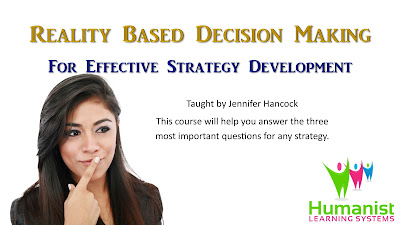
Image of woman looking thoughtful with the text: Reality Based Decision Making for Effective Strategy Development

Embrace Reality, Drive Success

At the heart of our course lies a humanist approach to critical thinking. We believe that by anchoring decisions in reality, individuals and organizations can navigate complexities with confidence and clarity. Our program equips participants with invaluable skills and techniques to hone their strategic acumen and foster a culture of informed decision-making.

What You'll Learn

Focus on the Real Problem: Learn a simple yet powerful technique to identify and address the core issue at hand, ensuring that your strategies tackle the root cause rather than surface-level symptoms.

Critical Thinking Skills: Explore the six essential critical thinking skills necessary to ground your strategies in reality. From analysis to inference, our course empowers you to dissect information, challenge assumptions, and arrive at well-informed conclusions.

Scientific Evaluation of Alternatives: Discover methodologies to objectively evaluate alternatives, employing scientific rigor to assess potential outcomes and mitigate risks effectively.

Learning Objectives

By enrolling in our course, you'll achieve the following objectives:

Master Organizational Change: Gain insights into developing, influencing, and executing strategies for managing organizational change, enabling you to navigate transitions with agility and foresight.

Strategic Decision-Making: Acquire the expertise to actively participate in strategic decision-making and due diligence activities, contributing valuable perspectives and insights to your organization's growth trajectory.

Strategic Planning Proficiency: Develop a comprehensive understanding of the strategic planning process, from design to implementation and evaluation, empowering you to drive impactful initiatives aligned with overarching goals and objectives.

Elevate Your Decision-Making Skills Today

Whether you're a seasoned executive, a budding entrepreneur, or an aspiring leader, our course offers unparalleled value in enhancing your decision-making prowess. You'll gain practical insights and actionable strategies to navigate the complexities of modern business landscapes with confidence and conviction.

Earn Continuing Education Credits

For professionals seeking continuous growth and development, our course offers the added benefit of earning continuing education credits, ensuring that your investment in learning yields tangible rewards both personally and professionally.

Conclusion

In a world defined by uncertainty and ambiguity, the ability to make reality-based decisions stands as a hallmark of effective leadership and strategic vision. Join us on a transformative journey to unlock your full potential, drive meaningful change, and chart a course towards enduring success. Enroll in "Reality Based Decision Making for Effective Strategy Development" today and embark on a path of discovery, innovation, and unparalleled achievement.

Are you ready to shape your reality and shape your future? Enroll now and embrace the power of informed decision-making.

https://humanistlearning.com/realitybaseddecisionmaking/

Available as a certified online course, streaming video, book and audio book. 

The Art of Patience: Navigating Challenges with Self-Compassion and Critical Thinking

In a world that moves at an ever-accelerating pace, patience has become a rare virtue. I'll be the first to admit that I'm not naturally a patient person. The urge to solve problems immediately, to untangle every knot in the moment, often leads to impatience. Over time, I've learned that acknowledging and overcoming impatience involves a delicate dance between self-compassion and honing critical thinking skills.


Understanding Impatience as Panicking

The Impatience Conundrum:

Impatience is, at its core, a form of panicking. The desire for quick solutions, instant gratification, can cloud our judgment and hinder our ability to think critically.

The Panic-Immediacy Connection:

When faced with a problem, the instinct to solve it immediately often stems from a sense of panic. Understanding this connection is the first step towards cultivating patience.

Self-Compassion: A Balm for Impatience

The Power of Self-Compassion:

Self-compassion is the antidote to impatience. It involves treating oneself with the same kindness and understanding that we would offer to a friend facing a challenge.

Embracing Imperfection:

Acknowledge that it's okay not to have all the answers right away. Embracing imperfection allows room for growth and learning, reducing the pressure to solve everything immediately.

The Role of Critical Thinking

Pause and Reflect:

Critical thinking involves taking a step back and objectively evaluating a situation. When impatience strikes, consciously pause and reflect on the bigger picture.

Analyzing Options:

Instead of rushing towards the first solution that comes to mind, employ critical thinking to analyze various options. Consider the potential outcomes and consequences.

Long-Term Perspective:

Critical thinking encourages a long-term perspective. What may seem urgent in the moment might not hold the same weight when viewed in the context of broader goals and objectives.

Letting Go and Coming Back

The Power of Detachment:

Learning to let go is a valuable skill. Sometimes, stepping away from a problem allows the mind to process information subconsciously, leading to fresh insights upon return.

Revisiting with Clarity:

Coming back to a problem with a clear mind often unveils solutions that were obscured by the fog of impatience. The clarity gained through a break can be a game-changer.

Cultivating Patience as a Skill

Patience as a Skill:

Patience is not a passive trait but an active skill that can be cultivated. It involves practicing self-compassion, engaging critical thinking, and acknowledging the power of time.

Building Resilience:

Every moment of impatience offers an opportunity for growth. It's a chance to build resilience, learn from the experience, and approach future challenges with a more composed mindset.

Conclusion

As we navigate the complex landscape of problem-solving and decision-making, let's embrace the art of patience. By intertwining self-compassion with critical thinking skills, we can transform impatience from a stumbling block into a stepping stone for personal and professional development.

Call to Action

How do you navigate impatience in your life? Share your experiences and strategies for cultivating patience in the comments below. If you've found this exploration into the art of patience, self-compassion, and critical thinking valuable, you might find even more insights in my book, "The Humanist Approach to Happiness."


https://humanistlearning.com/the-humanist-approach-to-happiness-book/ In the pages of this book, I delve deeper into the principles of self-compassion and critical thinking, offering a comprehensive guide to navigating life's challenges with a humanistic perspective. Discover how embracing patience can be a transformative journey towards a happier and more fulfilled life. Grab your copy today and embark on a path of personal growth and resilience.

UFOs, Transparency, and Cognitive Dissonance: Exploring the Impact on Worldview and Humanism

 The topic of UFOs (Unidentified Flying Objects) has long captured the imagination of the masses, and it's become even more prominent with recent events, such as the congressional hearings and documentaries like "Encounters" produced by Amblin Entertainment which is owned by Steven Spielberg who made ET and Close Encounters of the 3rd kind using the head of Project Bluebook as a consultant.  

While the existence of UFOs remains a subject of debate, the issue of transparency, and the potential cognitive dissonance it may bring, is equally intriguing. In this blog post, we'll delve into the implications of keeping UFO-related information secret, the potential impact on different worldviews, and why transparency and openness are crucial for scientific progress and the humanistic perspective.

The Secrecy Surrounding UFOs

For decades, the secrecy surrounding UFOs has been a contentious issue. Some argue that this secrecy stems from the high number of false reports compared to genuine sightings. According to experts like the Project Blue Book consultant, only a small fraction of reports were deemed of unknown origin. 

Implications for Different Worldviews

However, a deeper, more unsettling allegation suggests that high-ranking military officials in the past were concerned about the implications of non-human intelligence on religion. In the 1950s, many military leaders were devout Christians, and some may have feared that acknowledging these entities as real would challenge religious beliefs, possibly leading to social upheaval.

The existence of UFOs, if proven, poses questions for individuals with varying worldviews. For atheists and skeptics, the revelation may not be as disruptive to their beliefs, given their tendency to debunk paranormal phenomena. However, for those with strong religious convictions, it could challenge their faith. Additionally, the emergence of new religions and belief systems in response to these "encounters" highlights the profound impact such knowledge could have on society's spiritual fabric.

Transparency and Scientific Progress

One of the most critical aspects of the UFO secrecy issue is the potential loss of scientific knowledge and research opportunities. Transparency is vital because it allows scientific collaboration and exploration. By suppressing information on UFOs, our government may have hindered the advancement of knowledge for over 70 years.  By keeping this knowledge hidden, we lost a substantial opportunity to learn and expand our understanding of physics and the universe.

When it comes to UFO or UAP phenomenon, naturalism is key. If something happens, there is a natural explanation for it. Supernaturalism is not required ever.  This means, if there are objects that can be observed to - teleport (move from 1 place to another without moving physically between them, then that observation tells us - teleportation is physically possible. If objects can move without propulsion systems, it means that is physically possible and that a natural explanation exists and that we can learn what that natural explanation is. 

The first step is observation and according to the government whistleblowers, that first step - observation - has occurred. We now need to move on to learning how it happens and how to control it happening. 

Failure to be transparent about this decades ago - put our research back - decades. 

The Case for Transparency

The lack of transparency surrounding UFOs emphasizes the importance of open, collaborative scientific investigation. It is a tragedy for humanity when information is hoarded rather than shared. Science thrives on collaboration, and none of us knows everything. To advance as a society, we must be open about what is known so that others can build upon existing knowledge. Whistleblowers from national security circles have stepped forward because they recognize the harm caused by the suppression of information.

Reframing the Questions

Instead of asking what UFOs are, we should question who we are as a species. The existence of non-human intelligences in the universe, if true, forces us to confront the essence of humanity and our place in the cosmos. This journey of self-discovery aligns with humanism, which is the applied study of what it means to be human. Acknowledging the existence of other intelligences can stimulate profound self-reflection and exploration of our human nature.

Conclusion

The UFO phenomenon and the associated issues of transparency and cognitive dissonance are complex and far-reaching. Regardless of one's worldview, the need for transparency and collaboration in exploring the unknown cannot be overstated. 

As we navigate the uncertain terrain of UFO encounters, we must remember that the pursuit of knowledge, understanding, and self-discovery are intrinsically human endeavors. In the spirit of open-minded skepticism, we should embrace the call for openness and transparency and embark on the journey of exploration, not just of the cosmos but of ourselves as well.

We should not let fear stop us from researching this. We should be open minded skeptics. Search for natural explanations. Don't be so skeptical we ignore the evidence being provided to us. 

If you have not watched the government hearings or Encounters - I think you should. It's a scientific and philosophic exploration of what people who claim to have had encounters are experiencing - both at the time and in the decades since their encounters. 

Constructing an Ethical Framework: Embracing Humanism for a Simpler Life

 In our quest for personal growth and fulfillment, we often find ourselves seeking an ethical framework to guide our decisions and actions. The journey towards constructing such a framework can be challenging, but fear not, for there is a philosophy that resonates with countless individuals around the world—Humanism.

In this blog post, we will explore the principles of Humanism as a powerful ethical foundation and introduce you to an online course called "Living Made Simpler," which offers invaluable guidance in aligning your life with Humanistic values.

Understanding the Search for an Ethical Framework:

Many people embark on a search for an ethical framework to navigate the complexities of life. We yearn for a set of principles that can guide us through moral dilemmas, personal growth, and meaningful relationships. While various options exist, one philosophy has emerged as a beacon of hope for those seeking a comprehensive ethical worldview—Humanism.

The Essence of Humanism:

At its core, Humanism is the applied study of what it means to be a good human being. It places value on human reason, ethics, and compassion, emphasizing the potential for growth and flourishing in each individual. Humanism seeks to cultivate a worldview that embraces compassion, critical thinking, responsibility in service of human flourishing. It promotes the idea that humans have the capacity to create meaning and purpose in life by embracing reason and acting with kindness and fairness towards others.

Why Humanism Resonates:

Humanism resonates with individuals from diverse backgrounds because it offers a framework that celebrates the inherent worth and dignity of all people. It encourages us to prioritize empathy, social justice, and the pursuit of knowledge, aligning our actions with values that promote human welfare and the betterment of society. By embracing Humanism, we can find clarity and direction in our ethical decision-making processes.

Introducing "Living Made Simpler" Online Course:

To help you navigate the path towards constructing an ethical framework rooted in Humanism, I've created the "Living Made Simpler" online course. This comprehensive course, offered by Humanist Learning Systems, provides practical tools and insights to apply Humanistic principles to your everyday life.

It was originally created as a 6 week program. it is comprised of 6 video lessons. and covers a wide range of topics, including:

  • Understanding the foundations of Humanism and its ethical implications.
  • Developing critical thinking skills to navigate ethical dilemmas effectively.
  • Cultivating empathy and compassion in personal relationships and interactions.
  • Applying Humanistic principles to social justice and ethical activism.
  • Creating a life that aligns with your values and promotes personal growth and fulfillment.

"Living Made Simpler" offers a transformative learning experience. Whether you are new to Humanism or seeking to deepen your understanding of its ethical framework, this course provides invaluable guidance and practical tools to incorporate Humanistic principles into your daily life.

Constructing an ethical framework for yourself is a significant step towards personal growth and leading a more fulfilling life. By embracing Humanism and its principles, you can establish a robust foundation that promotes reason, empathy, and social justice. Through the "Living Made Simpler" online course, you have the opportunity to deepen your understanding of Humanism and apply its ethical framework to every aspect of your life. Take this empowering journey, embrace Humanistic values, and experience the transformative impact it can have on your life and the lives of those around you.


Enroll Now

To enroll in the "Living Made Simpler" course and embark on a journey towards constructing an ethical framework rooted in Humanism, visit the official website:  https://humanistlearning.com/livingmadesimpler1/

False Dichotomies

 I've been chatting online with a rather smart individual who has been wanting to understand humanism and is asking me Socratic questions to try and understand it better.  The problem, he keeps posing things as false dichotomies.

So, let's start by understanding what a dichotomy and a false dichotomy are. Then discuss why I as a Humanist balk at them so much.

A dichotomy - is "a division or contrast between two things that are or are represented as being opposed or entirely different."   According to wikipedia - A false dilemma, also referred to as false dichotomy or false binary, is an informal fallacy based on a premise that erroneously limits what options are available. The source of the fallacy lies not in an invalid form of inference but in a false premise. This premise has the form of a disjunctive claim: it asserts that one among a number of alternatives must be true. This disjunction is problematic because it oversimplifies the choice by excluding viable alternatives, presenting the viewer with only two absolute choices when in fact, there could be many.

An example of this when discussing humanism might be asserting that either communalism or individualism is the key to understanding Humanism. That's a false choice. We can do both. Neither. Something else entirely.

Part of free thinking as a practice is to free your mind to think of other choices. That is how we creatively get out of problems and solve them.

Often, the choice is both and. It's not either or, its both and.  In the example above, Humanism as a philosophy is concerned about both the individual and the community in which the individual lives. Humans are autonomous individuals embedded in society. We are dependent on society for our well being. To create flourishing, requires balancing the needs of the individuals within the community with the needs of the community itself. Where that balance best lies is a matter of vigorous debate. And it's a debate totally worth having.  

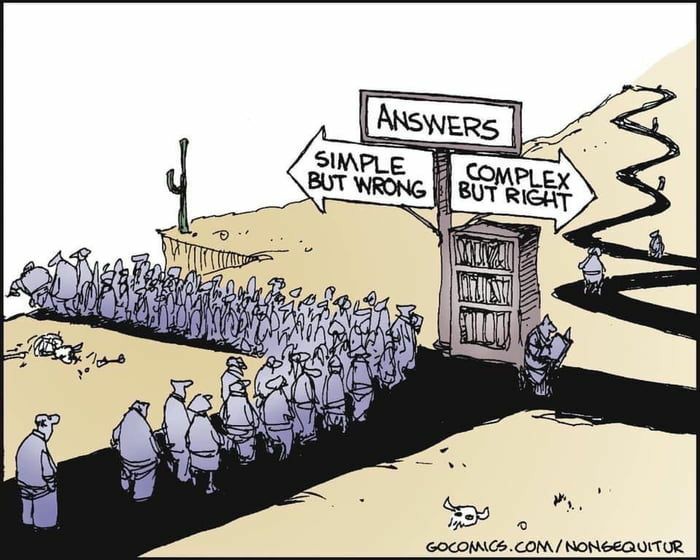
Why do I balk at false dichotomies? They cut off the debate. They assert it must be either one or the other and any choice made will be simple, but wrong.  I don't know what the right and best answer is. We may need to experiment, but what I do know is that choosing one extreme or the other will probably lead to unnecessary suffering and that's unacceptable.

Situational Ethics

And, like all things, the idea that all dichotomies are false is itself false. Sometimes, we have enough experience to know something is just wrong and harmful and no longer need to entertain it. Trickle down economics is one such thing. Nationalism is another. Supremacy of any kind is another. We don't have to weigh the good and bad and figure out how to integrate any form of supremacy into our solution. Doing so - even a little bit will cause more harm than good and we know this through experience.

So - looking for other answers that integrate both extremes is often a good strategy - but sometimes it's an insanely bad strategy which is why the situation and the specifics matter. If you try to integrate something that is demonstrably false, you will have problems.  

Nuanced

Which is why nuanced thinking is good thinking. To know whether you should try to integrate or not - you first need to think of the likely pros and cons. And we use humanist ethics to help us think of the pros and cons.  Does the solution help or hurt humans in general and in specific cases.

Nationalism and supremacy may help certain individuals but they actively and aggressively harm many others to do so - so it's rejected.

Compare that with a discussion on where to find the right balance between community and individual.  There are benefits and problems with both approaches. And it's possible to discuss how to find balance between the 2. Every nation and culture you look at finds the balance point in different places. There is no right answer to the question of how to balance individual rights vs community responsibility. 

There is definitely a wrong answer though. In places that are out of balance - where they go to an extreme - either extreme individualism or extreme communalism - suffering is always the result. Always. 

Nationalism is problematic because it's an extreme form of communalism. Supremacy is problematic because it marries extreme individualism with extreme communalism.  These view points are extremist because they are predicated on a false either or scenario. Either you dominate or are dominated.  A humanist knows those aren't our only 2 options.

Conclusion.

The questions this new contact is asking are interesting and thought provoking but also annoying because everything is posed in the form of a false dichotomy so I'm endlessly saying - it's not either or.  Environmentalism? It's not  - we do nothing or we go to an environmental extreme. We can transition and use our intelligence to solve our problems, but only if we don't shut off debate by insisting we either do nothing or we make things worse, which is how the right shuts off debate on climate. Heck - I'm in Florida - we aren't even legally allowed to discuss climate change. The words are banned in all government documents. It's silly and harmful. 

Don't fall into a false dichotomy trap. Recognize when yo are being given false choices. 


Critical Thinking 101

 Like everyone, I am being subjected to misinformation on a daily basis. And, I'm interacting with people who believe things I believe to be untrue. And like everyone, I'm annoyed at what I see as the crazy belief of others.


So, let's review critical thinking 101.  The best way to ensure you yourself don't believe things that aren't true, is to constantly look for evidence that what you believe isn't true.

Yes, this means, considering actively the possibility that what you yourself think - may be wrong.

You can't really help others with this. You can only really control what you yourself think.

So, the next time you encounter someone who says, you're wrong, ask them for the evidence that proves you are.  And if they provide you with that evidence, accept it. Read through it. Take it seriously.  The worst that will happen is, you will find out you were wrong and learn something.

What often happens when I do this is - I find out the other person was wrong. This doesn't make me happy. It makes me annoyed. But at least now I know. 

Taking this approach helps me have nice conversations with people because instead of arguing with them, I am asking socratic questions and they tend to like that as it helps them share what they think they know. It also opens them up to my questioning when I read say - a federalist paper they pointed me to - and I read it and find it seems to say the exact opposite of what they told me it says. 

At this point, we can have a genuine conversation - most of the time.  

I only do this when I am genuinely curious and want to know why people are thinking what they are thinking.

However, there is some science to this too - which is that introducing doubt and getting people to research their own beliefs, is what helps people deprogram from cults. 

So stop being so annoyed that the people around you appear to be in a cult, and start asking them questions - just in case, you are. 

Critical Thinking, Common Wisdom and mass hysteria

 I went to the McMartin Preschool as a child.  Yes, THAT McMartin preschool.  If you are not aware of it, there is a wiki page for it I'm sure.  For proof, I offer this photo of me (I'm the little one).  


It was apparently my birthday


What is alleged to have happened there is well after my time. When I went there is was super fun and I have nothing but happy memories.  I was actually enrolled in a psychological observation program. I would go to McMartin in the am and then to an observation play group in the afternoon. I have REALLY fond memories of both the people at McMartin and Ms. Whitehead, the psychologist. 

Later kids, especially the kids that attended during the period of time where abuse is alleged are traumatized. Whether they suffered abuse or whether their trauma was induced by well meaning psychologists interviewing them, I don't know.

What I do know is that most of the most egregious allegations simply aren't true.  

Clearly - there were no tunnels under the place. You cannot tunnel into sand without building a cement structure to keep the sand out. You just can't. All they found was some disturbed dirt. If anyone wants to dispute this, understand that if archeologists can find tunnel walls that are thousands of years old in Egypt, then disturbed dirt with no tunnel walls found means there were no tunnels under the building. Even if you backfilled it - you would still find what are obviously tunnel walls. They didn't. 

I also find it very hard to believe that Virginia McMartin did anything to harm any child. If kids were being abused and she found out, she would have stopped it.  I don't have proof she wasn't involved, but I believe she wasn't. Ray? Possibly. 

Finally, there was no evidence that there was a satanic cult involving prominent people in town. This sort of thing would have been an open secret if it was true, and nothing. There is no contemporary accounts from adults who witnessed or participated in such things. And no, that doesn't mean there is a conspiracy. Sometimes absence of proof means there is no proof. We have plenty of evidence of what happened with Epstein. None to say a Manhattan beach grocer was involved in a satanic cult. Houses were searched - nothing was found, not even in the dirt that was alleged to have been a tunnel. (Seriously - you could not build a 40 foot long tunnel without people noticing or finding concrete evidence of it). 

Yet, despite this having happened decades ago, and despite the lack of evidence for tunnels and some sort of satanic conspiracy, people still believe that there were tunnels running ALL over town and that there was a massive satanic cult involving prominent people in the community who were allegedly using the tunnels to shuttle kids around town for sexual rituals. Again, let me remind you, there were no tunnels and no evidence of any satanic rituals found anywhere. 

If the whole, tunnels and satanic cult holding satanic sex rituals sounds familiar, it's because most of the narratives for the  current satanic child sex ring conspiracies that are apparently happing in tunnels underneath everything from pizza parlors to whatever odd business, are all based on this first one. 

The investigations and trials into McMartin lasted years! They were among the longest in USA history and ended with no conviction and if you read the link below - you will see that many of the allegations made were too fantastical to be real. To this day people in Hermosa and Manhattan Beach CA who lived through the investigations and trial don’t want to bring it up because there are still people on both sides of this who are adamant about what did or didn't happen. This case tore my community apart and yes, I was living in the community when this all went down. I was in high school when the first allegations were made.  I lived through a mass hysteria event. 

https://www.investigationdiscovery.com/crimefeed/crime-history/5-facts-you-need-to-know-about-the-mcmartin-preschool-satanic-sex-abuse-trial

The saddest part was how many lives were destroyed by this and how divided it made my community. Kids were traumatized, adults were too. Several companies with no ties to the McMartins went out of business because people became convinced that a local grocer was part of some non-existent satanic cult. It didn't matter that no tunnels were found to link the grocer to the school as was alleged. People still believe despite all the evidence to the contrary that has come out since then. 

What happened was crazy. The community is still divided over this 40 years later. There has been no reconciliation between the people who accepted the results of the investigations and the people who still absolutely believe the kids. Further, the kids who were molested or have come to believe they were molested (https://www.ncbi.nlm.nih.gov/pmc/articles/PMC6818307/) were and still are traumatized by what happened.  

It doesn't matter that almost all of the crazy allegations that were clearly untrue - were proven to be false. People still believe them anyway. And again, I don't know if kids were abused - it's possible they were. I'm speaking only about the alleged tunnels and the alleged satanic conspiracy). 

How do I know people still believe this? Because my brother innocently posted photos of my family from 1970 of us at the pre-school and unleashed the controversy all over again. 

Which brings me to my topic: Critical thinking, Common Wisdom and mass hysteria. Part of my practice as a Humanist is to use critical thinking to help me solve problems.  My rules: 

1)  Don’t believe everything you read.

2) Common wisdom isn’t necessarily correct.

3) if you are getting worked up into a frenzy – you are probably being manipulated. 

First, critical thinking says, in a beach town where everything is built on sand, a massive tunnel system that stretched a couple of miles with lots of branches going to lots of different buildings would have a) required a massive public works project and b)  would have been easily found since to create such a tunnel system would have required concrete. Backfilling in such a tunnel would have left the walls of the tunnel.   

Common sense also says, there is no way a preschool could have created or maintained such a thing and given that no evidence of any tunnel was found anywhere, that this part of the allegations is obviously untrue.  

Finally, if a conspiracy involves more than one person, then someone will find out and it won't be a conspiracy for very long. The truth will come out. 

Again, this doesn't mean kids weren't molested at the school, it just means, the part of the story that involved tunnels and a satanic cult was clearly NOT true and couldn't be true.  

This is where the mass hysteria comes in. Common wisdom isn't always true. Just because a LOT of people (say half a town) believe that there is a Satanic cult that has somehow  built tunnels all over town to shuttle kids from a preschool to satanic rituals, doesn't mean it's true.  It is ok to question common wisdom. How should you decided who to believe? Don't believe people - believe the evidence. 

Finally, if you feel yourself getting really upset over allegations, you are probably being manipulated.

Why tell you this now? Because once people believe these things, evidence to the contrary doesn't change their minds. At no point have people who believe in this conspiracy, accepted the overwhelming evidence that there were no tunnels. Kids were harmed (either by a child molester, or by the investigators or both). 

Today's conspiracy theorists, will most likely believe their conspiracies until they die. This means, the people who believe there are satanic sex cults today involving high ranking people, will not just magically go away or change their minds when presented with contrary evidence. The people who believe Trump won the election despite the overwhelming evidence and certification that he lost, are still going to believe that going forward.

We have to figure out how to get along despite a large portion of our communities believing things that aren't true. (And if you are a believer, you believe that the people who don't believe believe things that aren't true - this goes both ways). We need to figure out what the truth is and we need to figure out what to do about people who believe things that aren't true.  This is especially important if elected officials believe things that turn out to not be true. 

The other thing we need to realize is - prevention is better than the cure, because there is no cure for this. Delusion is a life long problem. We need to really figure out how to prevent delusions from taking root in the first place. 

Finally, these beliefs morph and spread and they are never harmless. At this point, the belief that there are satanic child sex rings all over the world, is widespread. It's literally impacting national politics.  Obviously, child sex abuse occurs and we need to deal with it, but the whole - child satanic sex rings in tunnels conspiracies -  have been thoroughly debunked and it simply isn't part of how children are trafficked for sex in the real world. The focus on something that isn't happening, is taking away resources from dealing with the abuse that actually is.

People - we need to get our heads right and stop treating crazy beliefs as ok. They aren't. They do real harm to real people and really do tear communities apart.


Learning how to argue effectively

I was recently introduced to an online game that teachers logic and debate and more importantly the rules of debate and how to recognize valid and invalid arguments.


It's a pretty cool game to play and a neat way to learn debate techniques.  How to ask questions and get clarification so you can understand what is being said in a debate and what it means.

You will notice - it's a game that teaches you how to ask questions.  Not how to argue. And that's important because the skill of asking questions - good questions - is a good skill to learn. It's also how you learn to "win" arguments. 

You can play the game here for free - http://socratesjones.com/

Now - if you want to learn how to win a debate or how to win an argument - you need to take my online course on Socratic Jujitsu - https://humanistlearning.com/socratic-jujitsu/


I'm told I give really good advice.

Whether you are dealing with a difficult situation at work, or you want to reconcile with an estranged family member.  I can help you think more clearly and therefore more effectively about your problems so that you can solve them in a way you are going to feel really good about.


How do I do it? Applied humanist philosophy. Actively invoking your ethics as you decide what to do about any given situations, tends to yield good results. Seriously it does.

First, taking the time to think, interrupts your instinctual response so that you can choose your response.

Second, thinking about what a good response would be - first requires you to do some thinking about what a good or ideal outcome is.  Notice, this involves the word - good - which involves moral judgement.

Third, once you know what it is you ideally would like to have happen, you can be strategic about how you go about accomplishing that.  I spend a lot of time talking to people who have an outcome in mind and are doing the exact opposite thing to what they should be doing to get what they want.  It's crazy to me.  Take some time to think about the consequences of your actions so that you can have some idea of whether want you want to do will work or not.

Finally, I help give permission to people to strive to be a good person. It's really ok.  Your struggles are normal. Life is hard. Choosing to embody your values doesn't guarantee success, but spending some time  engaging in critical thinking and challenging your assumptions helps.

One way to think of Humanism is that it is the applied study of what it means to be a good human being.  Think of what a good person would do - and then do that.

The compliment to Humanist morality is critical thinking.  We humanists do both.  Compassion tell us what a good outcome is. Critical thinking helps us create a strategy to actually accomplish it.

Finally - the last component is responsibility. We know what the right thing to do it. We have a plan on how to accomplish it. But none of that matters if we don't take action.

Reason and compassion in action. That is what Humanism is. And it really does make life easier.

If you want to learn more about how to actually apply the humanist philosophy in your daily life- I have an online course to help: https://humanistlearning.com/livingmadesimpler1/

Correcting Cognitive Bias to make life more fair

We all have a sense of fairness. And when we aren't treated fairly - we get cranky.   Whether people acknowledgement or not - we all have biases. And these biases impact our decision making.

One of the impact of this is that women and minorities - just aren't hired for jobs - they probably should be. And I talk to people who say - well - maybe they just aren't as talented - as the men.  But ... there is plenty of research on eliminating gender and minority markers - has a positive impact on "diversity" hiring.  The process - becomes more fair.

Here is a video about it.  Correcting for cognitive biases - taking affirmative action to correct for bias - yields better results. Not just for diversity - but for the quality of people hired. Because - let's face it - if the best person is a woman of color - and they are being discounted because of their gender and skin tone - then you aren't hiring the objectively best person for the job.


A big part of effective decision making and critical thinking skills - is learning to overcome your biases - so that you can make good decisions - based on what is objectively good - and not what you biasedly think is good.

This impacts - every decision you make!  So please - learn critical thinking skills and please learn about how to uncover and control your hidden biases.

Here is a free online course on cognitive bias - https://humanistlearning.com/controlling-our-unconscious-bias/
And one on reality based decision making - https://humanistlearning.com/realitybaseddecisionmaking/


Related Posts Plugin for WordPress, Blogger...