Showing posts with label professionalism. Show all posts

From Frustration to Compassion

Being overwhelmed is a constant problem. It would be nice if it weren't so. Learning how to not be so frustrated when life and the people around you are overwhelming and frustrating is one of the keys to being happy. It's hard, if not impossible to be happy when you are frustrated. 


 A lot of my clients come to me because they are frustrated. Either a person or a situation is causing them frustration. They want to know how to fix the problem. This is especially true when a client is a company. They hire me to "fix" a problem person.

And I help people, but rarely in the way they think I will. I help them by teaching them how to love. Love in the west is often associated with romance. But it has many dimensions and the practice of love, helps ease frustration and in turn, helps create - happiness.

And it's always amazing to me how many people resist this knowledge.  And it's not just me teaching it. Every major philosophy and religion teaches people to love. 

I had an epiphany on this a couple of years ago.

When people meet me, they realize I'm happy. And it's not an act. Most of the time, I'm in a pretty good mood.  And when I'm not, it doesn't normally last long.  I attribute my attitude to 3 things.  

1) I am biologically happy meaning, I don't have a mental health problem that makes being happy hard, like depression. My hubby suffers from depression on occasion and when he does, he needs medicine to help reset his brain and those medicines work. So, if your brain is a hinderance and not a help, seek help.

2) My philosophy, Humanism. This is a choice I have made about how I want to go through life.  If this is the one life I have, I might as well do the best I can with it - good and bad.  I'm ok with bad things happening, though I prefer good things happening. But more importantly, I refuse to stay stuck in bad things. I believe I can make the world better for myself and others, so I work to make that happen. This approach is a choice I've made and it helps me fill fulfilled and gives me purpose, which is important to being happy. We humans need to have meaning and connection to feel - good. So - I made that for myself and it works.

3) I practice love. As I said in the video, I actively think about and try to exude love. For myself, for my family, for my friends and for total strangers. Everyone.  It's my love for others, as an active practice, that helps me turn frustration into compassion.  When I find myself getting frustrated, and I do, I remind myself to think about the situation or the person, using love as my guide.  And immediately, my frustration ebbs away. And it works.  I find I can solve my problems better. Fix frustrating situations and deal with difficult people with the grace and compassion I expect from myself. 

How this applies to the workplace?

When I teach people how to stop bullying/harassment in the workplace, I not only teach the science of how to make it stop, I teach the mindset that helps you actually implement the science. And yes, that mindset is compassionate. It is extremely hard to do what works if you are angry. 

It's hard to make good strategic decisions when you are angry or frustrated. It's why the stoics encourage people to get control of their emotions. Thinking rationally is hard when our brains are overwhelmed with frustration.

Converting frustration to compassion helps get into the right mindset to create win win solutions for whatever the problem is. It also helps get into the right mindset to not be bothers by situations you cannot change.  In fact, I don't know how anyone complies with the Serenity Prayer if they are not practicing compassion and love. 


Humanistic Leadership, is loving leadership. If you are new to this, what I'd like you to do is try it. Next time you find yourself getting frustrated think - WWJD (What Would Jennifer Do). And what I would do is remind myself to love myself, love my family, love my friends and yes - love this annoying person who is frustrating me and only then, start thinking about how to fix the problem if it is fixable. And if it's not, walking away from it with love and a smile on my face. 

Good luck.

Also, if you want to take some of my course, visit: https://humanistlearning.com/ 

Clarity and Professionalism: VUCA


I can live with volatility, uncertainty, complexity and ambiguity. What I have trouble with is clarity.

You may have heard the acronym VUCA before. It stands for volatility, uncertainty, complexity and ambiguity. It's used in a business context to describe the reality of work. Which is that - things happen.

If I have a professional relationship with someone – the thing that gets us through the volatility and ambiguity and to work through the complexity – is having clarity on what it is we are trying to accomplish. Who is responsible for what etc.

To me – clarity is what helps makes getting through VUCA doable. It’s what reduces my stress. To me, this is what professionalism is. It's about being professional enough to help increase clarity so that the team can deal with the volatility and complexity  and ambiguity as a team.

Let me give you an example of what lacking clarity leads to.

I get booked a lot to give talks. In order to give a talk - I need information.

Like - WHEN is this talk going to take place. WHERE is this talk and HOW am I going to get there. WHAT exactly do you want me to talk about? WHY do you want me to talk about it?

These are all reasonable questions and without answers to them - I can't give someone my time.   When people book me - I expect clarity on these questions. When I don't get that clarify - I can't help anyone or participate in the meeting, or even if I do - I can't support the objectives of the meeting if I don't know what they are.  Providing me with this information - so that I can do my job - despite the unknowns - is what it means to be professional.

When I get a contract, the first thing I do after winning a contract, is call the customer and ask questions and answer questions so that - there is clarity between us about expectations, roles, duties etc. 

Things happen. A Professional works to make sure VUCA isn’t going to negatively effect us – and if it does, that we have the trust we need to overcome it.


If this is something you struggle with - consider taking one of the following courses.

How to De-Escalate Conflicts Using Science: https://humanistlearning.com/de-escalate-conflicts/

Or Bridging the Millenial Divide - which has information on humanistic communication strategies: https://humanistlearning.com/generationaldivide/


Professionalism as a cure for VUCA

I can live with volatility, uncertainty, complexity and ambiguity. What I have trouble with is clarity.

VUCA is a new-ish buzz word. It means Volatility, Uncertainty, Complexity, and Ambiguity. learning how to cope with VUCA helps you - cope and therefore be more successful.

I don't think I have a problem with VUCA. What I have a problem with is clarity.  I am ok with the struggles inherent in trying accomplish something. I expect things to change and be uncertain and to be more complex then original thought. I plan for that to happen.
What frustrates me to no end, to the point I'll lose my cool - is lack of clarity.  If there is not a clear understanding of what we are trying to accomplish and how we have decided to accomplish it - then getting through the difficulties - is impossible.


Without clarity - I have no clue on how to proceed to overcome the obstacles because I have no basis on which to judge - what a good solution to the problem is. I can live with volatility and uncertainty. I can't fix what is wrong though, without clarity.

I had a moment of clarity the other day. I have been working with an individual who is absolutely crappy about providing clarity. Most of the time I have no idea what they want me to do, how they want me to do it, when they want me to do it by or what resources I might be given to do the work that was vaguely suggested needs to be done. 

To me - this lack of clarity feels like lack of professionalism. If you ask me to participate in a meeting, but won't tell me when the meeting is, where it is, what the meeting is about, why we are having the meeting and what you hope comes out of the meeting, then, I can't participate in the meeting. This is basic stuff.

Which is why I have been thinking about the need for clarity as it relates to VUCA. We can't control everything, but we can at least provide clarity on what we want to have happen. To me, this is what it means to be a professional.

A professional works to make sure everyone is at least clear on what the objectives are, what the plan is, when we plan to do whatever it is and what resources we are going to use and who is responsible for what.

If I have a professional relationship with someone – the thing that gets us through the difficulties caused by volatility and ambiguity and what gives us the confidence to work together through the complexity – is having clarity on what it is we are trying to accomplish. Who is responsible for what etc.

To me – clarity is what helps makes getting through VUCA doable. It’s what reduces my stress. 

When I strive to be professional - this is what I am trying to do. Whether I think of other people as professional or not - has to do entirely with how well they create clarity and therefore confidence in myself and others.

I'm curious whether anyone else feels the same way I do about what it means to be a professional.

Overcoming challenges facing women in the workplace


One of the biggest challenges for women in the workplace is harassment - which can take many forms. 


At my last live training on how to use behavioral science to de-escalate conflicts, I got several questions from women that all amounted to the same thing.  How can I, as a woman, assert myself without being a bitch.  How can they stand up to their male colleagues, demand respect and be heard without pissing off the guys?  I get this question in some form in every single training I do. Sometimes it’s phrased as how do I stop being a doormat and stand my ground without being a jerk.

This shouldn't be a problem. Women should be able to assert themselves in the workplace without triggering a sexist response in others. But ... assertive women are viewed negatively by not just men, but by other women.

The solution to this problem has to
do with being professional and realizing that some men and some women can’t handle professional assertive women. At all.  That's the bad news.

The good news is that most can.

I’ve only ever been in 2 work environments where a man didn’t try to minimize my contribution simply because I’m female. It’s very very very common. My focus when dealing with these situations is not to try and fix the offending male, but making sure the other males – who aren’t jerks – understand my value. 

I do this by being professional and firm.  If something isn’t right or can’t be done in the timeframe or the request was inappropriate – I say no. Sorry – that can’t be done. Then I pivot to problem solving mode. Perhaps we can do this another way?  This technique is so simple I’m always surprised that more people don’t use it. 

Despite having been subject to attacks and rumors, I have always enjoyed the confidence and support of my supervisors. I don’t allow others to sideline me and I make sure the people who matter, know I matter. All by being professional and firm about my boundaries.

To learn more about how to win arguments without arguing - take my course on Socratic Jujitsu


Dealing with Personal Mistakes and Errors

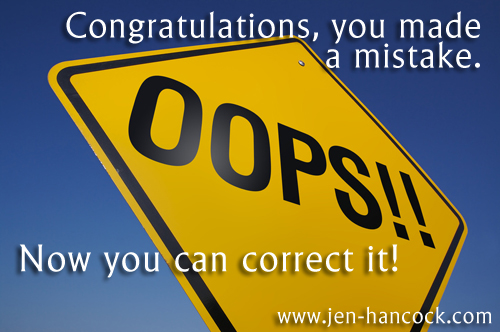
Everyone makes mistakes. Professionals fix them.


I am always amazed when I meet people who don’t want to take responsibility for their mistakes.  It’s not just kids, it’s adults too. I’m amazed because in my experience, acknowledging you made a mistake and working to fix it is always well received. I am positively re-enforced every time I take responsibility for my mistakes and try to fix them.

I have always found that people are pretty considerate, IF you work to fix the problem.

Sometimes my mistakes are an accident, and sometimes they result from poor judgement.

Sometimes, I mess things up with other people by being clueless, hungry or both. I’m far from perfect.

But, people still work with me and help me and support me and seem to like me, for the most part, because I do make an honest attempt to fix my mistakes.

My ego is pretty big, but it’s not big enough to prevent me from doing my best to fix things.

The next time you make a mistake or an error acknowledge it. Apologize for it. And start working to fix it. I have had people come to me livid about stupid stuff I have done and I’ve just flat out apologized and told them I messed up. How can I fix it?  Once people realize I’m not only not going to fight, I’m not going to blame anyone else for my bad behavior AND, I’m going to work to fix it, they almost always accept my help and allow me to make amends.

Don’t be so proud that you continue to make mistakes just to prove to yourself that you weren’t to blame.  That would be pretty stupid.

There are a few courses I would recommend if you find you struggle with this.
1) Conflict Resolution – will teach you some of the science of how to help resolve conflicts and prevent behaviors from escalating
2) Dealing with Cranky Customer Problems
3) Living Made Simpler (will help you think about your values, who you are and more importantly how you want to be)


Disagreeing – Professionally

The goal of any professional, or rather anyone who considers themselves to be professional, is to disagree civilly. That is what makes a professional a professional. They don’t get riled up.   This is professional, not personal.

That’s the ideal. The reality ... yeah – most of us get riled up. So, the question is – how can we maintain our professional standards of conduct and still disagree and still be heard and still make our point when other people are taking it personally.  And how can we not take it personally when they so clearly make it personal?
Related Posts Plugin for WordPress, Blogger...